An experienced guitar tech with over 16 years of experience working on acoustic Gibsons and Martins in the Gulf region.
There is nothing that cannot be repaired; the only consideration is the price at which it comes. And yet, if there is sentiment attached, no price is too high!
WhatsApp/Call me: 7080475556
email me: guitarguyhelp@gmail.com
I was awaiting a specialised drill bit to work the end hole of this guitar and finally received it yesterday. Here is the finished product.
The endpin jack in placeThe battery compartment stuck to the headblock, encased in its own thick, canvas casing.The volume and tone controls stuck to the soundhole
As you can see, these photographs were taken after I had strung up the guitar – almost as an afterthought.
Thus, I couldn’t capture the process of drilling the bridge through which the piezo pickup came up from under the top and now sits in the bridge, under the saddle.
Additionally, there is a microphone which is stuck to the bridgeplate, right under the bridge.
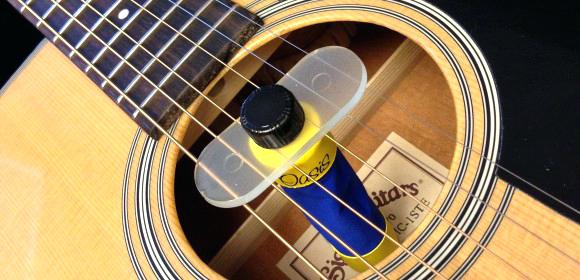
Of course, there are no photos of the microphone sticking to the bridgeplate but I searched the net and found this. At least it gives you an idea of how things sit.
pic courtesy sadek-music.com
Internally mounted microphones capture a guitar’s natural resonance and harmonic overtones. This one should capture the full range of the soundboard’s (top’s) projection in addition to resonance.
It is not uncommon for players to dress up their instruments: decals, stickers, signatures, et al, have decorated acoustic guitars, probably since the time they were begun to be made. A change of hardware on the guitar, then, is quite common to improve performance as well as the aesthetics of things.
I had to take off the gold hardware – the tuning machines and the strap buttons – on this milky beauty
and replace it with an all-black set. The new set had a gear ratio of 18:1 (to understand this concept, refer to my last post – ‘Wishing to buy a real guitar?’). Naturally, the strings too would have to be replaced. Though not a branded instrument and not made of solid wood, it played true, held tune properly, had excellent action at the 12th fret and at the bridge, and was an electro-acoustic guitar.
The most striking feature about the guitar was its abalone-like adornment and its f-shaped holes. F-shaped holes are a bit of a rarity in flat-top, American folk guitars with fixed bridges (bridges that are stuck to the top). Usually, one gets to see them on jazz guitars – quite a different set of strings – which have a completely different bracing pattern. The bridge on most jazz guitars is a floating one, which makes intonation adjustments a breeze, and strings just ride over it, being fixed at that end to a tailpiece and at the other, beyond the nut, to the tuning machines on the headstock.
The hardware that I was to put on it, looked like this:
I took off the strings and began taking off the gold hardware, when the thought struck me: what if the screw holes don’t match up with the new hardware? I took off one tuning machine and slipped in a new black one. Matching up the hole on the machine with the one on the guitar, I grimaced for, indeed, the holes were off by quite a bit.
I filled up the holes, painted each filling white and then let the guitar rest and dry. Then I marked the points where new holes would need to be drilled, measuring and cross-checking how the tuning machines sat in their slots and whether they were in line with those above and below them, as also whether they were in line with the ones opposite them. (I got so engrossed in the process that I forgot to take photographs of these steps – silly me!).
Anyway, new holes were drilled on the back of the headstock and the new tuning machines were screwed into place. This is what they looked like on the guitar.
Replacing the strap buttons was easy enough: unscrew old strap pin, take out, put new strap pin, screw on!
With new strings, the instrument was as good as new. And off went Venerable Vanilla home!
This post is aimed towards the intermediate-level player, who has now played for more than a couple of years and has attained a certain level of proficiency.
Wishing to buy a ‘real’ guitar, what are the things to bear in mind.
I saved these photographs with the file name ‘avoid’ and avoid1′!!This is something that you gift a child as a toy. It is not meant to be seriously played.
What to look for
1) The first and foremost thing to take note of when buying your first ‘real’ guitar is the wood used in its construction.
Why is that important? It is the top that moves when you strum a guitar. Its movement forces the air out of the instrument through the soundhole, and that produces sound. The more it moves, the more is the sound produced. To some extent even the back moves and helps in the propagation of sound.
So, if it is solid wood, the movement of the top (and the back) is that much uniform and better, vis a vis a plywood or a laminate guitar. Let me illustrate this by taking you back to school and into the physics class: refraction of light. Through a single medium, there is no refraction. And when light passes from one medium to another, the density of media comes into play.
Thus, if it is a single wood instrument, the transfer of sound is uniform without any loss of energy. In an instrument made of laminated wood, the varying densities of woods used are the reason for that dull and hollow sound that lacks sustain. The different woods absorb much of the vibrations, resulting in the ‘dead’ sound which you hear.
The wood combinations
There are traditional combinations of woods for the top, back and sides, which have withstood the ravages of their players and that of Time and have thus earned a reputation. The two most popular combinations are spruce and mahogany and spruce and rosewood – spruce for the top and mahogany and rosewood for the back and sides. Again, traditionally, the back and sides are always made from the same material – whether solid wood or laminate.
A Spruce top guitar (nkforsterguitars.com)A Mahogany back guitar (reverb.com)A rosewood back guitar (breedlovemusic.com)
Spruce is a lighter/softer wood in comparison to mahogany and rosewood, and thus lends itself well to its role of having to move once the instrument is played. In comparison, both mahogany and rosewood are harder woods, serving their purpose of providing structural support without impeding sound.
And then there are varying types of spruce and within each type, categories, which are graded. Besides rosewood and mahogany, flame/tiger/quilted maple, walnut and cocobolo are also used for the back and sides, while cedar is a popular option for the top.
A Quilted Maple back guitar (mangore.com)A Cedar top guitar (eBay.com)
Cedar is warmer/muddier than spruce (lending itself well for rhythm guitar playing). Likewise, rosewood is harder than mahogany and maple, making the instrument sound warmer – with more bass. Increasingly, koa is being used in place of all three, being cheaper.
A Koa back guitar (wiemerguitars.com)
With growing environmental consciousness, man-made materials have made an entry into the guitar industry with quite spectacular results, though it will be some time before they really catch the fancy of players.
How to check whether it is really solid wood
The back of a guitar
If you look through the soundhole of the guitar, you will notice a certain type of wood grain pattern. Turn the guitar around and look at the outside of the back of the guitar at the same point where you saw the pattern inside the guitar. If you see the same pattern outside too, it is a solid wood instrument.
2)The bracing
Under the top, there is a bulwark of (generally) spruce wood that helps support it. Now, you might think that if the purpose of the top is to move, when the instrument is played, won’t this bulwark hamper that? Logical but not true.
These struts, or braces – as they are rightly called – only brace the top and stop it from caving in under the pressure of the pulling strings. They are placed in such a manner that they not only support the top but also help it to move, when the instrument is played.
Just carving the braces and putting them on the top or the back is an art in itself, and in factories of the bigger guitar manufacturers, there is an entire department of workers that work on just the braces. And then there is the boss, who inspects each brace and how it sits on the top or the back. No wonder, you like the sound of that guitar!
Braces may be scalloped or unscalloped. While the former, naturally, are more rigid, the latter allow freer movement of the top and thus, clearer sound. So, what should you look for?
Unscalloped braces on a guitar (geocities.jp)Scalloped braces on a guitar top (harmonycentral.com)
If you are a finger-style player, go for scalloped braces. If you are a rhythm guitarist and love to accompany singers or players, choose an unscalloped instrument.
3) The Tuning Machines
If ever you try and replacing the tuning machines on your guitar, you will know that there is a huge price range they are available in.
You will be surprised to note that the most plain looking of them are more expensive than the more ornamental of them. And then there are those that are really fancy-looking and cost a right eyeball, a left ear and a right leg just for one piece!!!! This is because tuning machines are assessed on their gear ratio. The gear ratio is ascertained by the number of teeth on the gears of the machine, which helps tune the instrument to a greater accuracy.
On open-back tuners, you will be able to see the gear. Count the number of teeth on it. 12, 14, 16, 18, 21: the more the teeth, greater the accuracy.
The gearsThis is just a representation of the gear ratios that tuning machines have. Rarely does it happen that there are different gear ratios of different tuning machines on the same guitar.
The gear ratio is the number of turns of the tuning key which will make a complete turn of the string post. A tuner with an 18:1 gear ratio means that you would need to turn the tuner knob 18 times to make the string post go around one complete revolution.
When buying a guitar, once you have chosen the guitar that you wish to buy, ask the salesperson the gear ratio of the tuning machines. If you are not happy with the gear ratio, you can always have the tuning keys replaced with something better. But then, be prepared to shell out extra moolah for them!
Everything else!
If all of the above are in order, the rest, whatever it is, can be changed or replaced at a later date. Strings, saddle and nut, bridgepins, pickguard installation or removal, rosewood fretboard and bridge versus an ebony fretboard and bridge – even the fretwire – can easily be swapped one for the other.
The one reservation that I would make here is that though even the colour of the paint and polish of the instrument can be changed, it takes a real expert to strip the instrument of the finish on the instrument and put on new one.
It is not unheard of that while stripping a guitar of its finish, some part of the guitar got scraped off too!!!!
In conclusion
The cost of a real wood guitar is – at least – 10 times that of an ordinary guitar but then the manpower that is used to make it, knows what needs to be done to make a real instrument. And so it is that when you play a real wood instrument, you are forced to close your eyes at the beauty of the sound emanating from the instrument.
Also, a real wood instrument requires much greater care in terms of keeping the moisture content of the wood measured and replenished in times of need, failing which, it can easily let the rot set in.
DISCLAIMER: All of the above was general knowledge. There is nothing in this mortal world which says that a plywood guitar can NEVER sound as good as a solid wood instrument, or, conversely, a solid wood instrument CAN’T SOUND AS ORDINARY as a plywood instrument!!!!
Often, when the season changes you develop a cold and a cough. In much the same manner, your acoustic instrument is likely to develop a string buzz.
The reason for this is that wood being a dynamic material, expands and contracts under the effect of temperature and humidity changes of the environment. The wood expands and contracts at a certain rate but the metal fretwire does so at vastly different rate. This uneven expansion or contraction of the wood and frets results in the very irritating fret buzz.
However, the above statements are true only of solid wood guitars (those that have single pieces of wood as their top, back and sides, and are not made of laminated wood – plywood). And that is why changing seasons are deadly for solid wood guitars. So, why make them? Why buy them?
For their sound! You have to sit down with a solid wood guitar and play it to understand the pleasure of it.
You would remember me working on this beautifully constructed all-wood guitar. This came in again, recently, afflicted by the ‘seasonal fret buzz’.
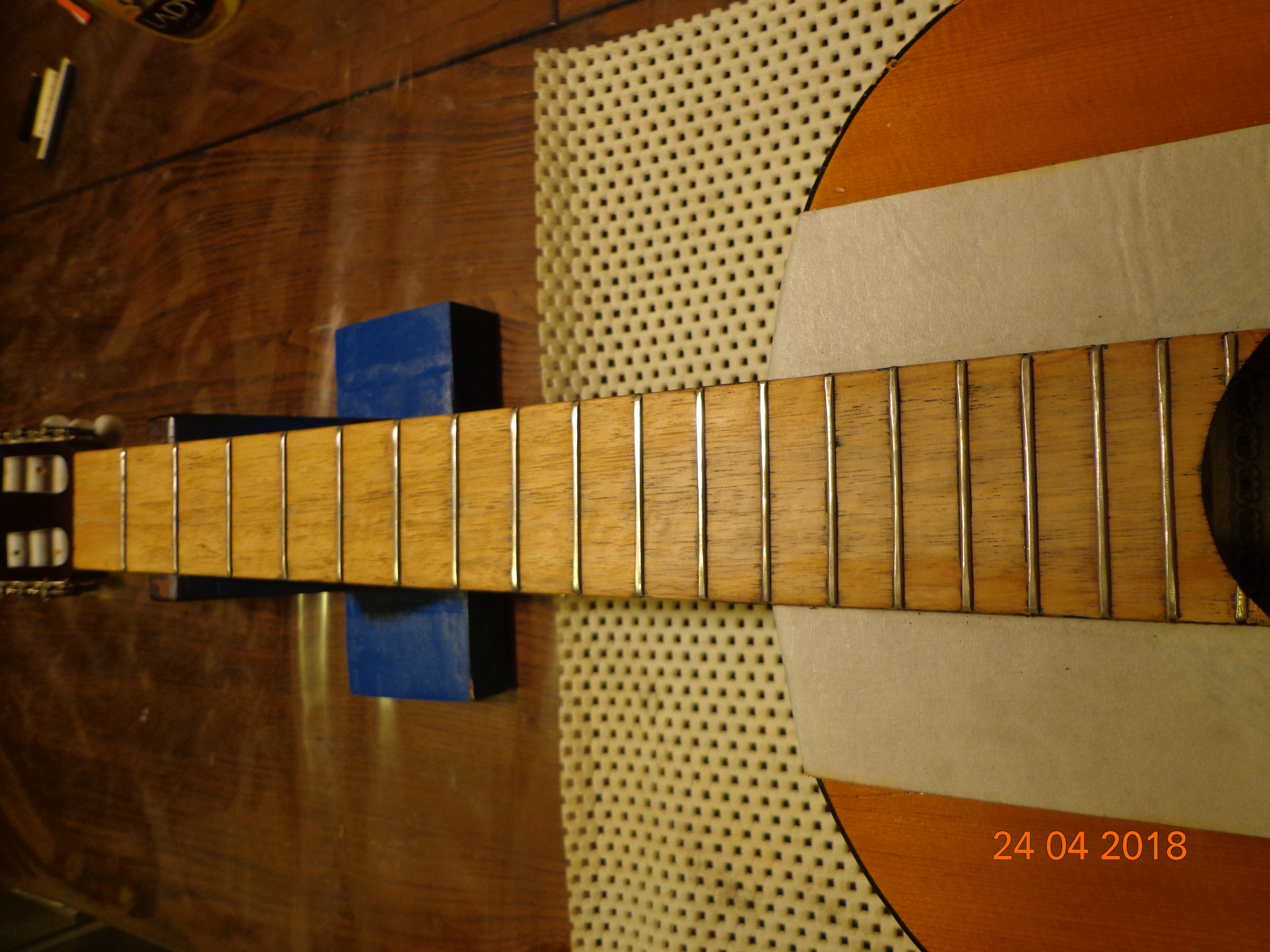
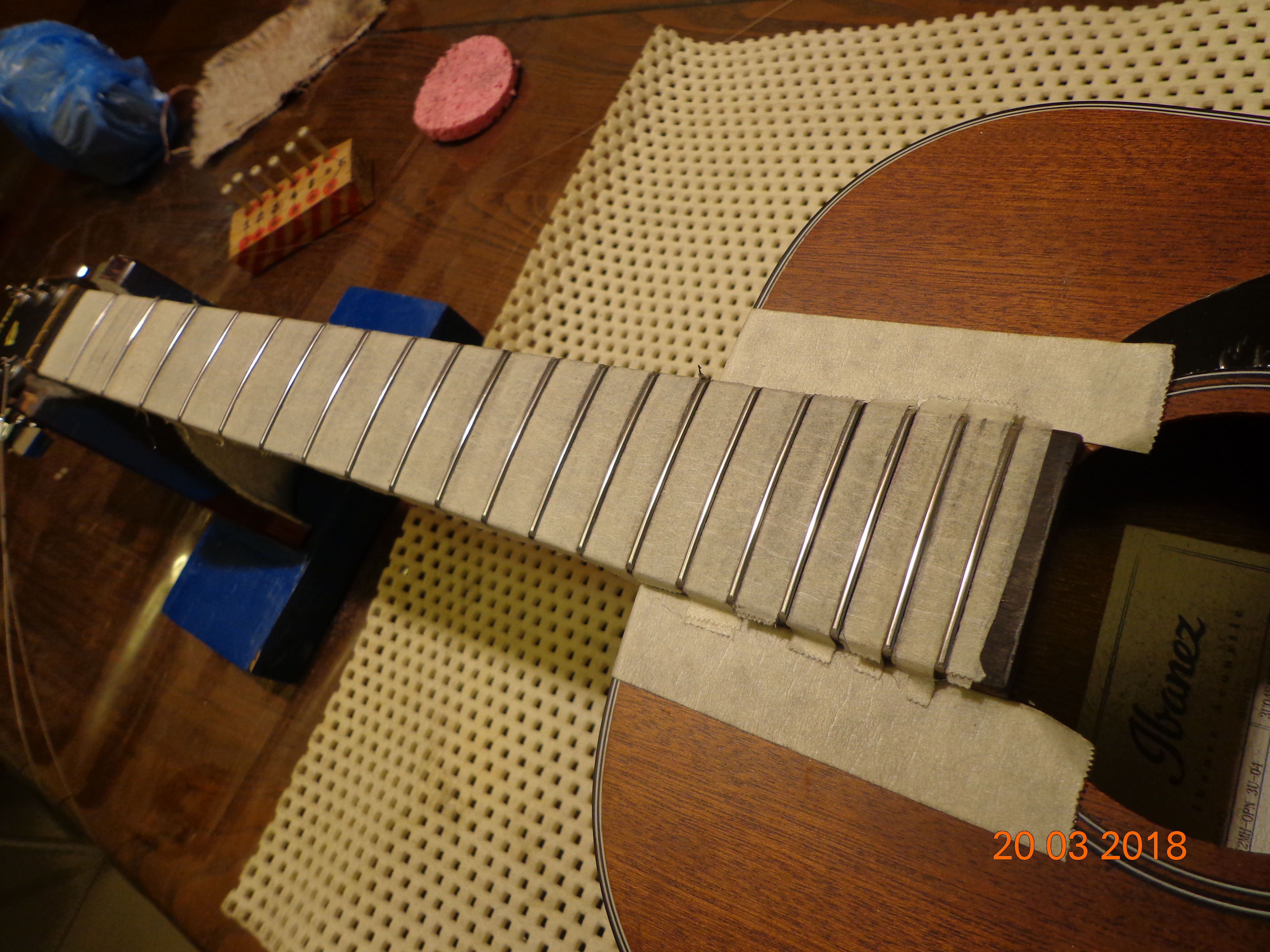
Trying to find the errant fret(s), I went over the fretboard with a fretrocker (a five-sided steel piece milled absolutely flat on each side), three frets at a time. Finally, I managed to locate the ‘popped up’ frets and marked them.
When one levels, radiuses and re-crowns the fretboard, one is tackling all the frets, but during spot-fixing, one only needs to focus on two or three frets (which are, more often than not, in succession). Thus, not taking off the strings to work on the frets is often possible, though I took off the strings on this one, as I had to change them in any case.
Otherwise, introducing two small wooden blocks between the strings and the fretboard, raises the strings and gives you enough room in between, to work on the frets.
The painter’s tape that I used was to protect the fretboard from the various files and grits of sandpaper used in getting the truant frets, first in line and then, in shape.
As I went about stringing her up, I found the action was high too. That demanded the saddle to be taken down.
The contraption I am using is sandpaper super-glued to painter’s tape, which is stuck to a piece of scrap MDF. The flatness of the MDF helps sand the saddle (or the nut) very straight, without there being any possibility of it tilting.
Finally, as I was tuning up the instrument, I was really pleased to notice that there was still an excellent break angle being created at the saddle. The steeper the angle at which a string ‘breaks’ over the saddle or nut, the more downward pressure it applies to that saddle or nut. That downward pressure helps in the transfer of sound, and thus, a fuller, richer sound.
Chilli here is in great shape – as you can see. It’s a 12-string Jumbo. I had to change its strings and give its fretboard and bridge a little drink of the magic potion, which while nourishing them, also made their grain pop. Eventually, I shone up Chilli even more.
This one is special. It has a bone saddle and nut…AND, abalone-topped brass bridgepins. They say that metal bridgepins seem to accentuate the high register of the instrument. We will check that out once we string ’er up!
But do look at that bridge. Beautiful! However, the overriding thought here is that because it is not a single, solid piece of wood, thicker strings just won’t do. Also, it’s a 12-string – double the tension that six strings exert.
Extra-light strings it is then (.010” – .047”). But even with a larger headstock stringing her up was a pain because the space between tuning machines is very small, and keeping track of ball-ends, which bridgepin goes into which hole, which string pairs with which string…
It took me a couple of hours but it was well worth the time. What’s more, the action on this stunner is lower than normal and there’s no buzzing anywhere along the fretboard.
And yes, the metal bridgepins do brighten up the sound appreciably, a joy for a finger-style player.
Extreme beauty – natural or manmade – has the ability to leave one speechless. I was too, after seeing this abalone-inlaid, solid-spruce-top, laminated-rosewood-back-and-sides beauty.
Suffice it to say that I have not seen a more beautiful acoustic instrument in my life, and believe me, I have seen a few. I could not believe my eyes and I just kept turning it over in my hands.
Admiring it, there were a few problems that were apparent. The action seemed sky-high and, of course, the bridge was lifting, as was the neck heel-to-body joint. I looked at the strings and they looked heavier than what I usually see. As I pulled out my digital vernier calipers and measured the thickness of the strings, they read .013” – .056”! And there lay the problem.
Ladies and gentlemen, boys and girls, if it is big money that you are investing in an instrument, PLEASE, also invest some time in reading the user/instruction manual very carefully. You have spent a decent pile on your instrument; spend a bit of time reading the manual too. If you didn’t get a manual, get onto the internet, type in the model number of your instrument and you will get a free user/instruction manual in PDF format.
In there, you will find all the specifications that you need – including what size strings are recommended. If it says use .010” (high E – thinnest) string, you can experiment with .011 string set, no thicker. You could even go one step down and try .09”, but that’s your leeway – one below and one higher.
The big boomers on this guitar – .013” – .056” – put way to much tension on the bridge and the neck heel-to-body joint, and this particular instrument wasn’t built to take that much strain. Naturally, it was literally coming apart at the seams.
The first thing to do was to take off the strings and let the guitar relax for a full day.
With the strings off, I decided to take a look under the hood. Handsomely scalloped braces supported the solid spruce top, though they could have been scalloped cleaner and neater. The bridgeplate was in not too bad a shape.
After that, I turned my attention to the bridge. After taping it off so that I wouldn’t scratch the beautiful finish on the top, I heated up the smallest and thinnest moulding knife that I had. With the knife hot, I went prising into the corner of the bridge that was lifting. Some minutes and a few bigger palette knives later, the bridge was off and in a relatively clean manner.
Cleaning and sanding off both surfaces under high magnification, I let that part of the instrument be as I concentrated on the more difficult job that needed to be done. I had to completely detach the neck from the body!
The need for doing it was because without taking off the neck, the crack would never be glued back cleanly and completely.
In luthierese (Did I just coin a word?), guitar-building jargon, the neck-removal is referred to as steaming off a neck, for you actually inject steam into the neck, helping melt the glue, which lets go of the neck, and you can then separate the neck from the body.
For that, you need to pull out a fret, drill a couple of holes and use them alternating between the two to inject steam. And that’s how it went. 35 minutes later, the neck was off.
While the glue was still gummy, I scraped off the majority of it, leaving the rest to be sanded off later. Then it was Rest time for the guitar and me. I left the instrument to dry off for a complete two days before I returned to it. Taking a file to it, I filed out the dried glue till only the wood could be seen on both surfaces (the neck as well as on the guitar). For the little studs, I cut strips of sandpaper and sanded them clean.
It was time to put everything together. But before that one last thing needed to be done. I took spirit and cleaned all the surfaces to be glued: the bridge, the top where it would sit, the neck heel and the portion of the guitar where it would stick.
First, I glued the neck back on and with some strategically placed wood pieces and clamps ensured that the joint would never come apart again. The major squeeze-out of the glue seen here
is not a bad thing. It shows that glue has reached everywhere and won’t let go. And it was nothing for a couple of wet paper towels. I left the neck clamped for two days to let the glue cure completely under pressure.
Next, it was the turn of the bridge. More glue, different clamps, more squeeze-out all around. More clean-up, another 48 hours. When I took off the clamps everything was dry and solid.
A dot of super glue in each of the holes I had drilled, sealed them and also helped hold the fret I had pulled out. The problem with the entire procedure is that even though the fret might be seated completely, it is seldom in line with the adjoining two frets. Either the replaced fret stands proud or is lower than the frets flanking it. So, a fret levelling, crowning and polishing was required and that is what I did for the next three-and-a-half hours!
I even lubed the fretboard and bridge and gave the entire guitar a good polish till it shone like new.
After that all that was left to do was to string ’er up and hear her sing. But I did put on lighter strings this time: .012” – .052”. The action was so low on it that I had to pull out the old saddle and put in a new, tall saddle. After putting in the new saddle, the action was still nice and low but without any string buzz.
Silly me…I got so happy seeing the action that I forgot to take a photograph! But she was a stunner, alright!
Black Beauty II (I have already dated Black Beauty – read earlier posts) was handed over in my care with the complaint of having an excruciatingly high action. I checked the usual culprits: the relief in the neck and whether the bridge was lifting. The bridge was, thankfully, stuck solid but the relief in the neck left a lot to be desired.
While inspecting the guitar – not a known name – a few things were highlighted. The plastic nut and saddle wouldn’t be doing any good to the sound of the instrument; the shoe-string tie of the guitar strap around the headstock was putting undue stress on the neck – it would have to go; the strings were dead – had been so since long; the hardware was all tarnished and a bit loose; and that the instrument in general was in need of real TLC (Bring out that vacuum cleaner, somebody)!
Also, the fretboard and bridge were dryer than tinder wood and the frets themselves were tarnished with minor pitting (indentations where strings struck the frets). As I inspected the guitar body, there was a chip on the outer extremity of the lower bout which exposed a bit of raw wood – probably caused by an accidental banging into something.
As I continued to go through the instrument under magnification and with a fine-tooth comb, I found the pickguard was lifting from the tip nearest to the fretboard. I pulled it off completely; the idea was to clean the pickguard and the area on the top where it was stuck, completely of the old glue and glue it back on.
If only things in practise were as easy as they appeared in theory! The glue around the periphery of the pickguard was dry and flaky. As I tried scraping it off, it left scratch marks like those when you scratch the painted side of a mirror: with light shining through! That being that I chucked the old pickguard and decided to put on a new one.
And then followed an unending experiment with solutions and solvents to take the drying glue off the top without harming the finish. Since you will screech in horror if I told you what finally worked, I won’t tell you! And a swanky new pickguard took the place of the old, cheap one.
Then I turned my attention to the hardware. With some magic lotion and lots of elbow grease the tuning machines shone like new.
I took off the shoe-string tie and prepared to install a proper strap-pin on the heel of the guitar. Drilling the hole to accept the screw of the strap-pin at that sweet spot is a tricky proposition. This one came out just fine.
Instinctively, I looked at the strap-pin at the bottom of the guitar. It was tarnished and beaten. So, I changed both, shiny and new.
Turning my attention to the fretboard, I scraped it clean, applied a double dose of nutrients – as also to the bridge – and recrowned and polished the frets. The end result was, indeed, pleasing to the eyes.
In earlier posts, I have failed to properly explain the process of replacing a plastic nut and saddle with bone elements. Let me set the record straight with this post.
First of all, what is the need to replace plastic parts? Plastic is cheap and easily available. Most guitar manufacturers (barring the biggest names in the business) put in the cheapest stuff possible to increase their profit margin – and that goes for everything that is your guitar – the wood, tuning machines, strings, nut and saddle. The plastic nut and saddle serve the purpose but when compared to bone, the volume and quality of sound is not even a patch.
This is due to the fact that bone is a denser material. Denser the material, greater will be the transfer of sound, and lesser the loss of sound while transferring from string to saddle/nut to bridge/neck.
After bone, a denser material is something called Tusq. It is synthetic but I won’t vouch for the quality of sound it produces. While I don’t like the sound from Tusq elements, for it lacks the mellow warmth of bone, many people do prefer it.
So…the plastic elements are taken out and bone elements put in. Hardly as easy as that! These bone elements are also mass produced and need to be customised to fit a particular instrument. For each instrument, the dimensions of these parts – like thickness and height – are different, which needs to be dialled in before these elements can work the best that they can with the instrument.
So, the nut was shaved down – both in height and thickness – as was the saddle.
Also, the nut slots had to be lowered to get the action on the guitar to an acceptable level. Once that was done, a carbon jelly was introduced in the slots so that the strings wouldn’t catch in the slots, while tuning up or down.
The angle that the strings make coming out of the bridge holes to the top of the saddle also has a big impact on the volume and quality of sound. With a tall saddle, strings can come straight out of the holes and the angle created is good, exerting a lot of pressure on the saddle, forcing it down into the bridge, which helps maxamise sound transfer and minimises loss of sound.
With a shaved-down saddle (to compensate for high action), the string slot has to be extended a bit so that that angle is created. The angle thus created, exerts pressure on the saddle, which, in turn, helps in a solid transfer of sound.
And finally, Black Beauty II’s coat was given a proper rubdown. See it gleam in health and happiness! Happy to see this beauty turn out the way it did!
If your remember, last time, I had said how the bridgeplate was a problem in this guitar. After much thought, I shaped two pieces of wood, stuck them together and then stuck and clamped them adjacent to the bridgeplate.
The idea was that this would only lend strength and support to the not-so-stout bridgeplate, helping hold the top of the guitar somewhat in place once the strings start pulling it up.
On a more expensive instrument, I would have suggested to the owner that a Platemate would be the way to go about it. A Platemate is a thin brass plate that is stuck to the bridgeplate and takes all the pull of the strings, protecting the bridgeplate.
Then came the turn of glueing and clamping the bridge itself.
The glue flows and moves into every nook and cranny, and once it cures, it forms a solid bond. But, in the process, the bridge holes also get filled with glue and get blocked so well that you can’t just poke through with bridgepins. The solution, then, is to open the holes using a drill and right-sized bit.
With the holes opened, and before strings came on, it was the right time to show a bit of love to the dried out fretboard. I had cleaned it earlier of all the gunk collected on it over its three-odd year life.
The fretboard scraped clean, the frets were crowned and polished and then the fretboard was given a drink of boiled linseed oil. So thirsty was the fretboard that the oil disappeared in minutes and I had to apply a second coat, which lent it a healthy sheen to the fretboard.
Then came the turn of putting in the saddle and the nut and setting up the guitar to play as perfectly as it should. Things to take into consideration is the gauge of strings used, the neck angle, etc. The nut requires a bit carbon grease in the slots for the strings to ride in them without getting stuck, or posing tuning issues.
The saddle needed a shave to get the action just right without any string buzz. An added consideration was that Snow White was an electro-acoustic beauty and thus, the under-saddle piezo pick-up had to be accommodated for.
That done, it was time to give the strings a stretch to get them used to the tension that they would be put under.
After stretching and tuning the strings a couple of times, it was finally turn to give the guitar body a good rubdown and polish.
This neatly finished guitar with abalone binding came in with the (apparent)complaint of a high action. It needed new strings too.
Simple enough? Spoken too soon!
As soon as I hear high action, my eyes automatically go to two places: the relief in the neck and whether the bridge is lifting under string tension.
And that was just the beginning of the list of woes ailing this pretty guitar. As I looked, I noticed that the spot where the ‘G’ string rode the saddle had been chewed into.
So, off came the strings and the saddle out of the bridge…not quite in one piece!
Then it was the turn of the bridge to come off completely; for the spot on the top where the bridge sat, to be cleaned thoroughly, and then for the bridge to be glued on, clamped and left undisturbed for at least 48 hours.
A few right-sized palette knives inserted in the right places helped pop off the bridge.
The bridge came off without much fuss but as it did, I saw clearly what I thought I had seen: a crack, or at least the beginnings of one, right along its centre.
Also, notice the bridge footprint on the top of the guitar. At least a millimetre or two was without glue. You can see it reflected in this next photograph of the bridge flipped over.
But as I looked at the bridge area on the top of the guitar, it seemed oddly misshapen. A simple ruler proved me right and that my eyes weren’t playing tricks.
And I knew that that could be caused only due to one problem: if the bridgeplate (a piece of wood stuck right under the bridge, whose job is to take most of the stress of the strings pulling up at the top and keep the top stable and straight) was weak, splintered or badly cut. Bridgeplates are particularly made out of hardwoods like rosewood, walnut, ebony and mahogany to take all that strain of the strings pulling up.
In this case, the bridgeplate was badly cut and made from silly wood. A bridgeplate made from ice-cream sticks would have provided greater support! Here is what I saw inside:
The flat piece of wood with six holes in a row is what was masquerading as a bridgeplate. No wonder the poor top was in misery.
What followed was a hot-water bath for the bridge area on the top and then clamping it under a block of wood for 24 hours.
When I took off the clamps, there was hardly any difference. So, while I thought about another way around the problem, I began to work on other parts of the guitar.
First came the cleaning of the area of the top where the bridge would sit: cleaning it of old glue, lacquer (varnish) so that once glued, the bridge would sit tight and never budge from its place again. An Xacto knife and two bridgepins helped me mark the boundary of the bridge.
If you look closely at the last photograph, you will be able to see how much varnish needed to be taken off all around for bare (bridge) wood to be in complete contact with bare (top) wood.
We went to work with a chisel and a few grits of sandpaper. Just like this:
That cleaned, I went to work on the underside of the bridge itself. The cleaned up bridge presented another problem.
The crack that I saw on the top of the bridge and thought was only superficial, actually ran through the bridge.
Meanwhile, the fretboard had enough DNA on it to map the family tree of the owner; the frets needed crowning and polishing, and the tuning machines needed to be worked on too.
What I did with the bridgeplate and what were the hits and misses till I handed the guitar over to the owner: coming soon.
YES! I know I have written about how to go about choosing a guitar, but I am being forced to write about it again with a special focus on children, thanks largely due to the sudden flood of queries from parents.
FOR SMALLER CHILDREN
What size to buy
The ideal age to start learning any instrument would be six years, once the child has attained a degree of motor control. The ideal size for the child would be a smaller guitar – referred to in the guitar industry as a 3/4th guitar. But there is a certain shelf life to the instrument because just as the child outgrows his/her shoes and jumpers, so will he/she outgrow the instrument too.
picture courtesy: gumtree.com
Not that he/she won’t be able to play the instrument but there are two scenarios here: a) either he/she is so comfortable with the small-sized instrument that he/she finds it rather cumbersome playing a regular-sized instrument, or, b) they are so cramped for room that they are terribly uncomfortable playing the small instrument.
So, the downside of buying a small instrument is that in the end IT HAS TO GO! It might adorn a wall but will be seldom played. If there is a younger sibling/cousin/friend the economics of buying a 3/4th guitar work out that much better.
A word of caution though, A TOY GUITAR IS NOT A 3/4th GUITAR!
What type – steel-string, nylon string or electric?
The steel-string guitar is more for accompaniment – to sing along to – while the nylon-string guitar is more a specialist classical music instrument, meant to sound finger-picked notes that make the basic melody of the song. It is ideal for Western Classical Music.
While the steel-string instrument is generally played with a pick or plectrum – never overruling the fingers – it is a SIN to even lay a pick or plectrum on a classical guitar, which is (or should be) played only by the fingers.
There are basic differences in how the steel-string and the nylon-string guitars are constructed, which dictate the way each is played.
The sound thus produced from a steel-string guitar is happier and peppier, while the sound of the classical guitar is softer, mellower, meant to be consumed personally.
The electric guitar has its own image, personality and points to consider.
3/4 electric guitar. Picture courtesy: gear4music.com
In the end, choosing a guitar is for you and the child to decide together.
What price range?
This is something that I leave parents and guardians to decide, for it is they who will have to shell out the moolah. It is not wise to buy a really cheap, or a really expensive guitar; for the simple reason that a cheap instrument may not last your child’s childhood!
Also, it is likely to put off your youngster for various reasons like comfort, sound quality, etc, etc. Never, think that your brat won’t know the difference. They’re into YouTube as much as they are into Cola, and they listen to stuff!
Expensive stuff: not worth it, for, in the end IT HAS TO GO!
It is then wise to walk the middle line and try and find the best instrument that you possibly can in the middle range.
FOR CHILDREN 11 YEARS OR OLDER
Full size! No question about it. Children this age have grown enough to be able to handle a full-size guitar. If they are facing a bit of a problem forming and holding chords, it will disappear within a few months as their hands dial in the ‘stretch’ required to hold chords and shapes.
The more they practise, the more they will acclimatise to the instrument, the sooner their playing will become ‘clean’ (chords and notes ringing out clear).
And if it wasn’t evident from these couple of paragraphs at which age the switch from a 3/4th to a full-size guitar should be made, it is age 11!
And since it is a full-size guitar that you are looking to buy, all the recommendations I made in the earlier piece, become considerations. Read that piece here:
Happy New Year, good people (even you baddies!)!!
May all of you have the best year yet!
My New Year resolution: not to miss my date with the Lucknow Guitar Garage, ever again!!
But without ado, let’s talk about saddles and their slots. But first…
pix courtesy: graphtech.com
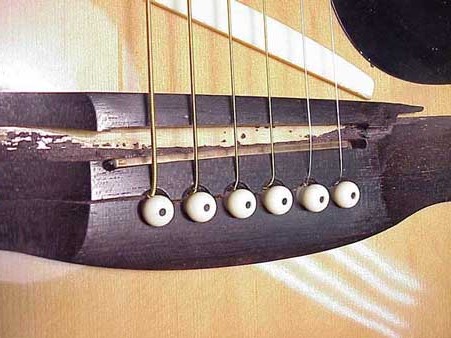
…for those among us still uninitiated in guitar anatomy, the white, round things are called bridgepins, the other white long piece is called the saddle, while the wood they both sit in, is called the bridge.
With that out of the way, let’s get into more technical stuff (without meaning to scare you!).
The three things in bold (above), along with the strings, basically, constitute the quartet responsible for producing sound. But as that adage goes, there’s many a slip between the cup and the lip!
Distances, depths, breadths…many possibilities for a slip.
Have you seen/heard of bridges getting cracked?
This can happen for more than one reason. The incorrect size of bridgepins, saddles vis-a-vis their respective slots, is one major reason which can cause havoc.
Picture this:
a) a thick saddle in a thin bridge slot
b) a thin saddle in a broad bridge slot
c) an optimum-sized saddle in an optimum-sized bridge slot, but which is not deep enough…
…MANY A SLIP BETWEEN THE CUP AND THE LIP!
With this pictorial representation, try and grasp the second scenario…
The thinner saddle in a broader slot tilts the saddle, exerting extra force – thanks to the tension of the strings – on the area of the bridge nearest to the soundhole.
However, if the bridge slot is shallow, this extra force of the saddle is absorbed without damage. But, if the saddle slot in the
bridge is deep, the front edge of the saddle is where a fault line is created. Not immediately, but it is along this fault line that the bridge cracks. Just like this:
pix courtesy: (richboromusic)
However, if the saddle sits tall and upright in its slot, there’s nothing to fear. In fact, if the saddle position on your guitar looks like this, you can feel good about it.
pix courtesy: acousticmasters.com
In extreme cases of saddle-slot mismatch, this may happen:
pix courtesy: frets.com
And yet, not always can you attribute such damages to physical dimensions of components. That old devil, Humidity, plays a part too.
Lesson learned?
See that your saddle width is just enough to make it sit snugly in its slot. The saddle should not drop out of its slot, neither should it require needle-nose pliers connected to a suction pump to pull the saddle out of its slot!!
And this is how your bridge assembly should look like:
pix courtesy: frets.com
And then again, the health of the bridge is secondary. Once the saddle is near perpendicular to the bridge, the transfer of sound from the strings to the saddle, to the top…ah, the ball is well and truly set rolling!
UNTIL NEXT TIME, keep checking your saddles (and their slots)!
Those, in my opinion, are the two most FAQs by newer guitar players. Often, even experienced players don’t ‘know’ why they use the strings they use! Ask them and they say things like, “I have always used these”!!
Here, I will concede that the range and types of strings available in the market can make choosing a set a formidable proposition. You must consider things like gauge (size), material, coatings, and brand names. If you are a new player it becomes that much more confusing.
The best way out is to read up and educate oneself about the strings available and find out which type of music you like to play on your acoustic instrument. ‘Knowing’ the strings is also important because using the wrong strings may damage your instrument.
pix: dylanbakermusic.com
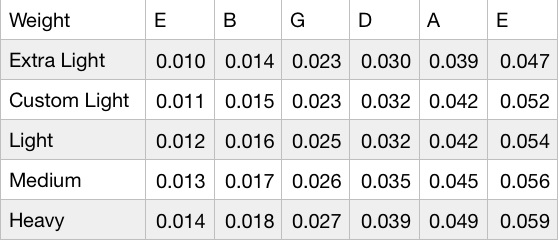
String sizes are measured in thousands of an inch and it’s common to refer to an entire pack of strings based on the size of the first string. For example, if you want to buy a pack of new strings, you could ask the shopkeeper for a pack of ’10s’ of a particular brand.
The chart above is representative as string manufacturers tend to have slight differences in thickness of strings of the same gauge from their competitors.
Heavier strings are louder and richer in tone though they are tougher on the fingers. This may increase frustration among beginners. In contrast, lighter gauge strings don’t produce as much volume and the tone is considerably jeopardised. However, they are easier for beginners to play and to bend.
The DreadnaughtThe Jumbo
Different acoustic guitar bodies require certain gauge of strings. Bigger or jumbo sized bodies are usually better suited for medium or heavy strings while smaller parlor sized guitars tend to perform best with light to medium-light gauge strings.
Your playing style
The finger-style player – depositphotosThe strummer – depositphotos
This too, is a major factor in choosing strings. If you prefer to play finger-style, you should go in for light or medium-light gauge strings. If you usually strum your guitar, you should try medium to heavy gauge strings. If you do both, you might want to find a set that’s the right balance between light and heavy.
The heavier the gauge of string, the more tension it will produce from the guitar headstock to the bridge. Neglecting to properly set up your guitar when replacing strings to a heavier set, or, downgrading to a much lighter set could damage the guitar. Talk to a guitar tech before making dramatic string size changes.
I would suggest for newer players to play everyday at least for an hour, and to change strings every two months. Each time, pick a different type of string set, play it and record it. Once you have tried all string types, you can go back to your recordings and choose the string type that best pleases YOUR ears.
Yes, the initial investment will be a lot and frequent but you and your playing will gain a lot from the process.
How often to change?
This is a very subjective question and the answer depends on how much and how often you play your guitar. Professional players are known to change strings every two or three days!
More casual players, who pick up their guitar twice or thrice a week for 30 – 45 minutes must change their strings every three months. Experts are of the opinion that every two months is the ideal time but I would suggest a string change every three months.
Whether 2 – 3 days or 2 – 3 months, know that a change of strings is mandatory. With usage and being under constant stress, strings undergo a lot of wear and tear which is not apparent to the naked eye, but you can certainly ‘hear’ the strings go ‘dead’ after a certain period of time. They will just not ring out the way they used to.
TIP: If a string breaks, never try to change just that string. Change the entire set!
Just like after a period of time your shaving razor gets dull and you have to change it, so also it is with strings. The following chart will help you understand string changes better.
TIP 2: Once you have decided on a string type, don’t just buy one set. Buy 3 sets at one go. While you put on one set on your guitar, there will be two sets waiting, just in case you break a string. Even if you don’t break a string, you will have two sets ready to put on once it is time to change the strings. You will not only save on time but even on effort.
I will be installing a pick-up in this baby. The pick-up resembles one from the L.R. Baggs’s Anthem series greatly.
I have already drilled the hole for the pick-up
But before anything else, try and identify this beauty. That is the whole purpose of this post!
I have purposely blackened the logo and the name on the headstock, as also on the label inside the soundhole. But, to aid you in the identification process, I will tell you its salient features:
Solid Sitka Spruce top
Mahogany neck, back and sides
C’mon! Look at that beautiful sunburst!Think about it till Sunday, when we get into the business side of things.
This Epiphone came in for a general check-up, cleaning, fresh strings and a bone saddle and nut. It had been in disuse for a number of years and now that the owner had time on his hands, he decided to make use of it by brushing up on his strumming skills.
Otherwise a solidly built guitar, I was surprised when I could not knock out the plastic nut installed in the instrument, using the usual means that I employ. I had to hold it with a pair of pliers and with much effort, prise it out of the slot. It came out, eventually, but in pieces. Take a look at the photo above and see if you can count the number of pieces it shattered into.
To my horror, I saw that some HII (high-IQ individual) had used epoxy to glue the nut in and there was enough residue in the slot to fill a gorge in the Grand Canyon! To my eyes it seemed as if I was the first repair person to have touched the instrument, and so, could it mean that people at Epiphone used the epoxy? There was no knowing.
Just cleaning the slot was a tedious 50-minute procedure, employing various means and tools. The problem was that I could not get too happy with the tools. Just a little extra sanding and I would be sanding away too much of the nut-end of the fretboard, which would mean reducing length of the fretboard, which meant reducing the scale length. When I was done, I had managed to work up a healthy sweat, not due to exertion but due to nervousness.
While replacing the nut, ideally, if the slot is cut correctly, one does not require glue. The nut sits snugly in its slot and is held in place by the strings. However, glueing it in place is not wrong either…BUT…only with two little dots of glue – NO MORE – on the side of the nut that will sit against the fretboard.
The cleaning, oiling and polishing of the guitar took me another hour, give or take a few minutes.
With a spanking new nut and saddle in place, I restrung the instrument with 0.12 – 0.53″ gauge strings.
A proper set-up and a string-stretching followed with the action reading 0.79″ at the 12th fret and 0.15″ at the 1st fret.
A mighty pleased owner picked up his instrument later in the day, bringing smiles my way too!
It’s almost a month since I posted and if you have visited the home page of my blog recently, you may have noticed a very stark address change. The shift was in the pipeline and happened just at the right time for me.
Yes, I won’t be there to help people in Qatar and the region, but the internet is a wonderful thing – you’re never far. Through this blog and the email, I will still be able to solve most of your problems, or, at least, guide you into solving issues you face with your acoustic instrument.
As I write this post, I sit almost 3,000 km from where I began writing this blog, but I am home, I am happy, and I am raring to go.
There will be a change in the day of posting, though it will still remain a weekly post. Instead of Friday, you will now be able to read new blog entries by me on Sundays.
As you may have noticed, there is no phone number in the contact details. It’s coming soon.
Just a little update on what’s been happening. Until Sunday then, keep it here!!!!
This pretty guitar with an equally pretty bridge of nicely figured rosewood came to me looking like this. The gap between the bridge and the top was big enough to let you drive through a truck and must have resulted when the owner left it standing for months with the strings in full tension.
A word of caution here: if you know that you won’t be playing your guitar for a few weeks, PLEASE loosen your guitar strings. It takes away the stress the strings put on the bridge, on the crucial neck-to-body joint, the neck itself, and stops the guitar top from bellying up behind the bridge. Basically, loosening your instrument’s strings is good all round.
Besides, this instrument had a few other problems but none as major as the lifting bridge. The cheap plastic strap-pin was falling off, the fretwires and the chrome hardware was tarnished and needed burnishing, a fresh set of strings was needed, and the plastic nut and saddle needed to be replaced with bone elements. However, the owner did not wish to replace the nut and saddle.
When I began removing the bridge, it offered little resistance and popped right off. But what I saw underneath left me wide-eyed.
There was a disconcerting shine on the top where the bridge sat, as well as under the bridge, and as I took a closer look, it seemed as if the manufacturers had tried to save money on the glue. It appeared as if the entire top had been sprayed with lacquer (varnish) and while the lacquer was still wet, the bridge had been placed and pressed in, in the hope that as the lacquer dried, it would work as a glue. All this is pure conjecture on my part, but to be very frank, there were few traces of glue both on the bridge as well as on its footprint on the top.
Now, granted that this was not a famous brand name, but it was a very well constructed instrument with good wood used in it. Why somebody would go through all the trouble of selecting good material and make an excellent instrument and scrimp on glue, beat me.
Whatever! My job was cut out – or, rather – gouge out all the glue. A painfully slow process, I scraped, filed and sanded close to three hours to get all the lacquer off from underneath the bridge and the top. Here’s proof:
When I finally sat down, perspiring and hot, the sight in front of me was indeed heartening.
Clean, wholesome wood shone through. Do appreciate the highly figured rosewood used for making the bridge.
Cleaning the two surfaces to be joined thoroughly, I applied glue, brought the two together, clamped them up good, and left the joint to cure for almost two days.
While the glue was curing, I worked on the fretwires and hardware of the instrument, giving it some polishing cream, some TLC and lots of elbow grease.
Just look at them shine!
The fretboard oiled and nourished, and the fretwires burnished and shining like new.
The clamps came off and with a good polish of the body the guitar shone with new light, with new strings completing the picture. Do notice the shiny new strap-pin. Its twin sits as snugly on the side of the cutaway.
This Ovation look-alike came in for new strings and a general set-up. It was pretty much like Ovation down to the fiber bowl-shaped back.
However, most amusing was the strings’ artwork on the headstock.
The extra length of the strings needs to be cut off for it is of no use and can only cause problems. And do notice how the D string tuning machine is bent at an angle.
The little screw holding the tuning machine had got bent and in doing so had bent itself out of its slot, creating a deep furrow. The only thing stopping the tuning machine from coming out of its slot was its nut on the front face of the headstock.
I took off the tuning machine and filled up the furrow and the screw slot with wood and glue. After the glue had dried, I re-drilled a hole in the proper place and replaced the old, bent screw with a new one. I also oiled, tightened and polished all the tuning machines.
Also, there were major divets in the first four fretwires and even though this is not a very clear photograph, I think you will be able to make them out.
I had a chat with the owner about working on them and about replacing the cheap, plastic nut and saddle with bone elements. He agreed and I set about my job.
With a little love, some ‘0000’ steel wool, oiling and lots of elbow grease the fretboard and the fretwires were shining again.
The guitar looked and sounded better than it ever did!
Measuring the action – thebasicsofguitar.blogspot.com
The action on your guitar is high and you take it to your technician to correct it. If he says it is a two-minute job, and picks up the hex key (Allen wrench), stop him then and there.
By picking up the hex key, what he intended to do, most probably, was to work the truss rod one way or the other. The truss rod is an iron rod with a hex nut on one end and sits in a groove in the neck, right under your fretboard/fingerboard. It can be accessed either through the soundhole, or from the headstock end.
The trussrod end as seen through the soundhole – tdpri.comThe truss rod with access from the headstock end of the guitar – thbecker.net
The purpose of the truss rod – in any guitar – is to dial in the right amount of relief (the string-to-fretwire gap) in the neck. IT IS NOT A PROCESS TO CORRECT ACTION, no matter what your tech or anyone else says.
Pic courtesy sweetwater.com
The right way to correct action on your instrument is a three-step process, correcting
a) action at the 12th fret (adjusting saddle height)
b) action at the 1st fret (adjusting the string slots in the nut), and
c) dialling in the right amount of relief in the neck.
I will discuss these in the next post with a set-up undertaken on a customer’s guitar.
This troubled six-string came in with the complaint that the action had got particularly high on it. During routine inspection it became clear why.
Apologies for the bad shot but this was the best among three or four that I took!
The bridge was lifting badly all round the end facing the end block. When a bridge lifts like this, the action is bound to increase, making playing the instrument a pain. In order to correct it, the bridge had to be taken off and reglued to the top.
But to be fair, this instrument was a mystery to me. The headstock read ‘Takamine’ (pronounced ta – ka – mee – nay), a respected Japanese brand founded in May, 1962, but the label inside the soundhole read:
‘Made in China’! Made in China??
Whatever!!!
I had a job to do and the quality or the make of an instrument should never be a concern, and it never is.
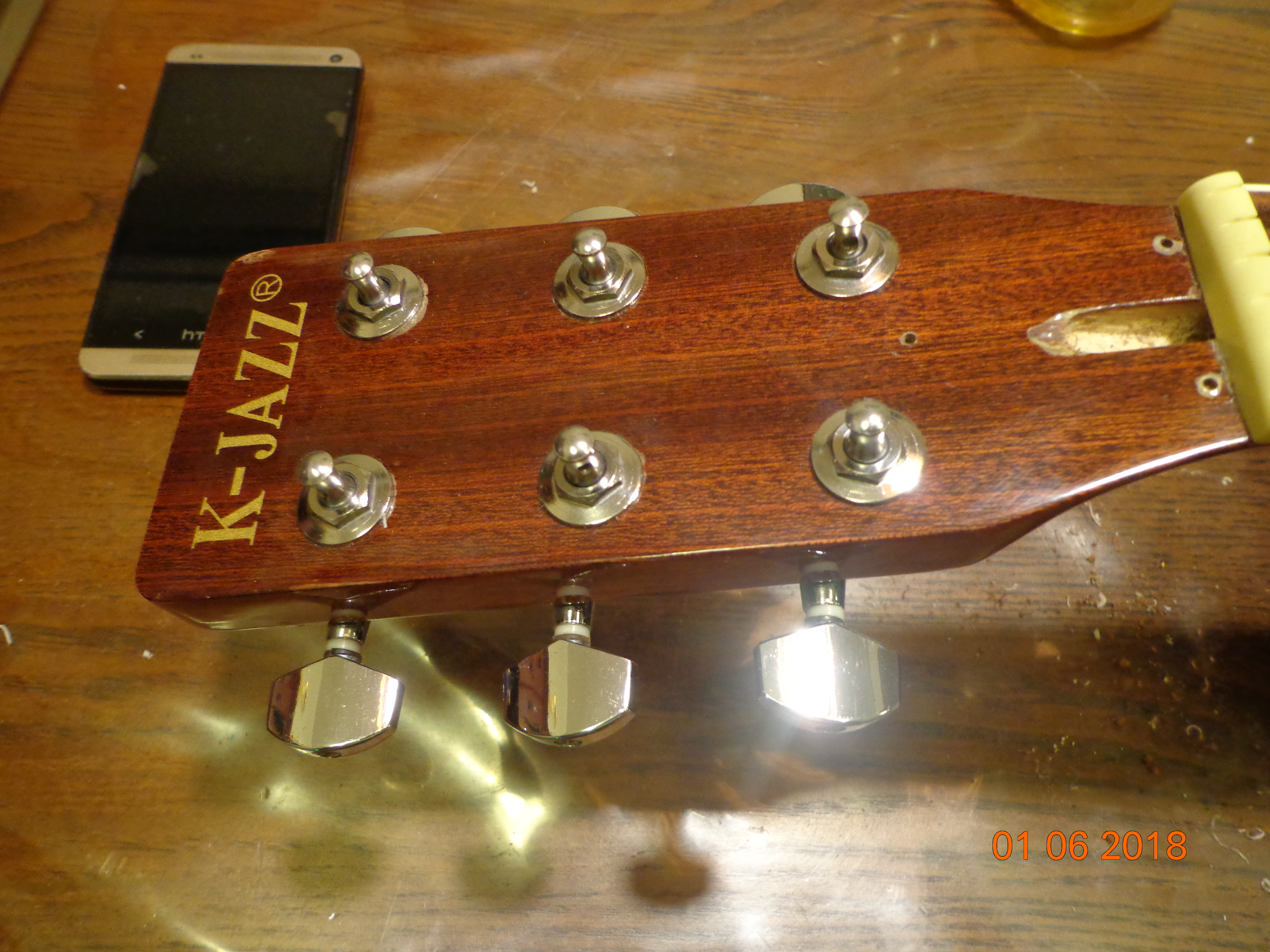
As I continued to inspect the guitar, I saw the usual things: plastic saddle and nut, grime collected over months of playing, huge divets in the fretwires, and of course, the instrument needed new strings.
The grime and the divets in the fretwiresSome more grime and the plastic nut
However, the biggest surprise awaited me when I took the bridge off. It popped off with little resistance but both the top of the guitar as well as the underside of the bridge were coated with an odd, shiny substance, which resembled varnish. Only, varnish can never function as glue!One look at it and I was grimacing for I knew what lay ahead: hours of scraping and scratching and cleaning before it was completely rid of the goo. Exactly two hours and forty-five minutes later, the bridge and the area on the top where it would be stuck, looked like this – finally!I glued on the bridge and clamped it down to be left for 48 hours like that. In the meantime, I went about working on the dented fretwires.
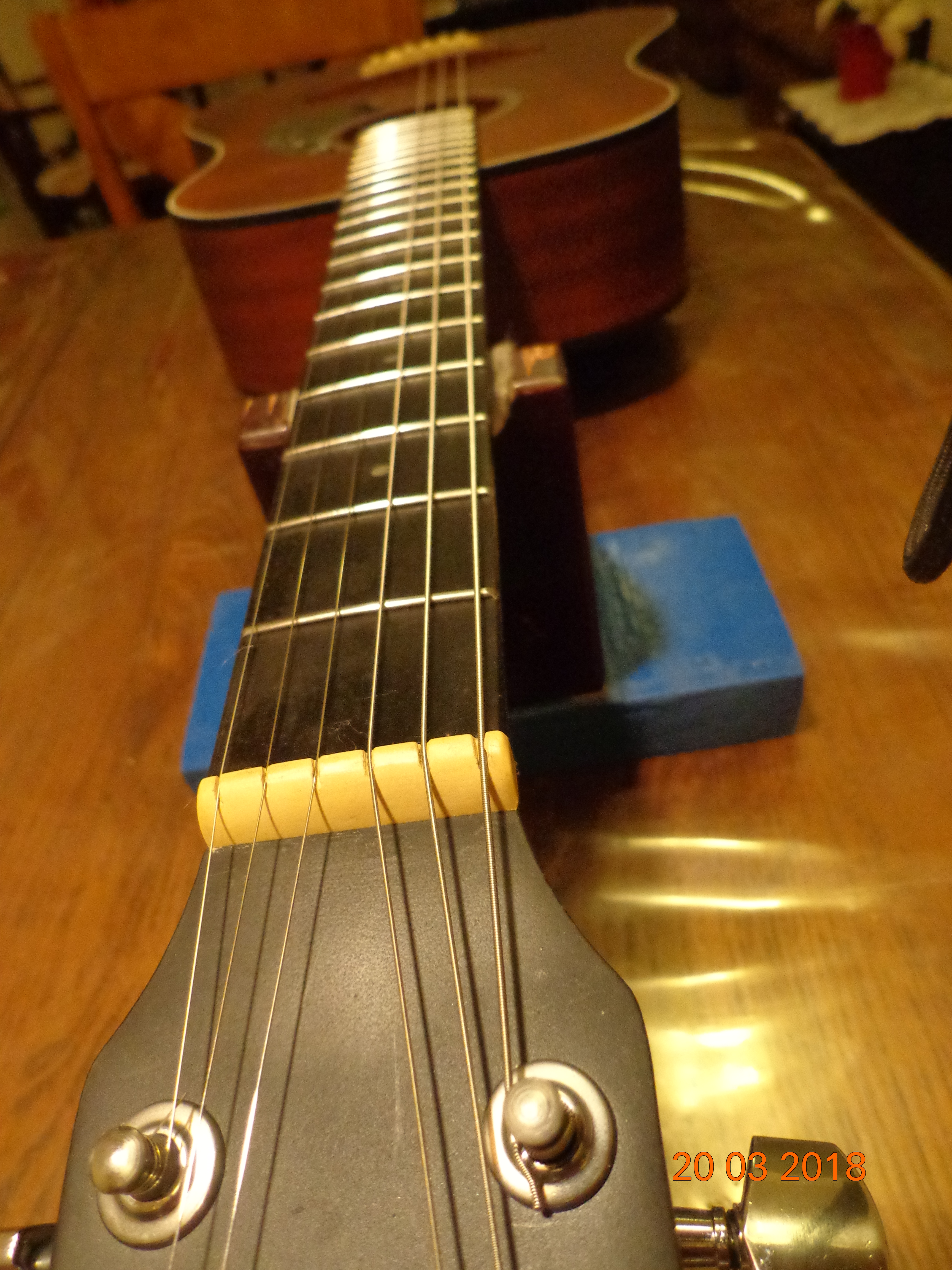
Only the first four or five needed attention and so I worked only on them, some financial respite for the customer.
Also, the plastic saddle and nut were replaced with bone elements that would not only last a lifetime but provide quality sound too.
You played your guitar the night before and when you pick it up in the morning, the action on the instrument is sky-high.
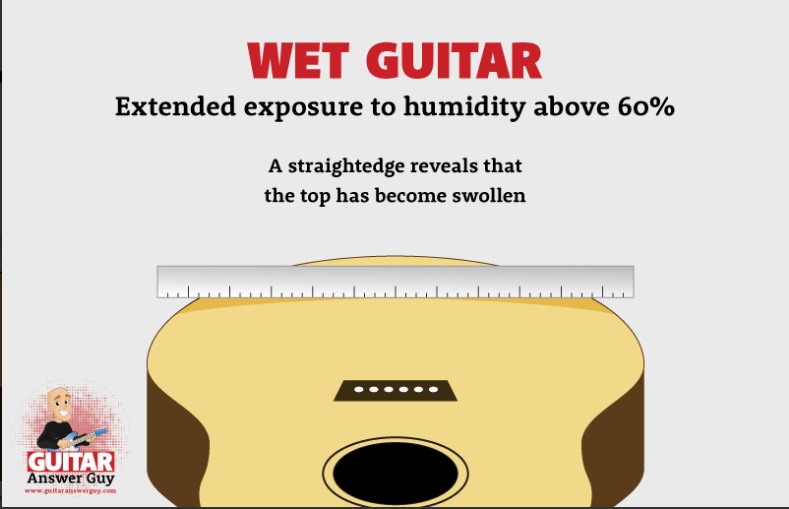
This happens more often than not due to humidity – too much humidity – which is not often discussed. It is also possible that the neck may have moved during the night, causing the strings to rise over the fretboard.
A friend had this very expensive guitar which he used to religiously humidify. In fact, when he used to return the instrument to its case, there was a humidifier waiting there to feed it!
So, one fine day, when he picked up his instrument to play, he could hardly play it. Astounded, he checked everything and when he could not find the problem, rushed over to show it to me. Here is what I told him:
“When you are hungry, you eat, and you continue eating till you are full. What would happen if you continued to eat even after you were full?”
“I would bloat,” he said, still puzzled at where I was getting with me targeting his gastronomical proclivities.
“Exactly!” I said. “Your guitar has had too much to eat, or rather, too much to drink. The bloating is due to the fact that the wood in your instrument has taken in way too much water than it required. In fact, you can see it here”. And with that I took a 12″ ruler and laid it across the top just under the bridge. While the centre of the top was in contact with the ruler, the ends of the ruler were high in the air, just like this:
My advice to him was to loosen the strings, take the humidifier out of the case and not to humidify the instrument at least for three weeks.
My friend got back to me in two weeks to report that the instrument had lost its belly and the action too was back to normal. I asked him maintain the no-humidity regimen for a week more before he started humidifying his instrument again.
My next piece of advice to him is also the advice I give you.
“Of course, you must humidify your guitar but then you must know when your guitar has had enough to ‘drink’. You will only know this if you have a small but reliable hygrometer kept INSIDE the guitar itself. Having a humidifier in the case of the guitar will never give you a very accurate picture of the humidity level of your instrument.
This instrument might appear large but fits easily in your palm and also inside your guitar.
After every four or five days check the reading on it, and once your guitar reaches that optimum range (45% – 55%) of humidity, stop feeding it water.
Relatedly, the tension of the strings acting on the neck might cause it to bend one way or another. A simple, 1/4 turn of the truss rod should be enough to correct the problem.
A guitar player of any proficiency level must have a few essential tools to help him/her maintain the instrument.
The No. 9 wrench is used to keep the tuning machines snug and doing their job properly.
The stringwinder is used to hasten a job that you would otherwise do by hand
A brush is always handy to dust places that are hard to reach (for eg, the area underneath the strings)
The wire cutter is needed to snip off the extra length of strings when you change them. A tip: Please desist from creating modern art with strings on the headstock of your guitar. There are other places that you can show your creative talents.
The hex key or Allen wrench is used to work the truss rod of your guitar.
The needle-nose pliers are essential for holding and turning small pieces like strings.
A small Phillips screwdriver is most handy for it can be used at various places to tighten small screws in your instrument
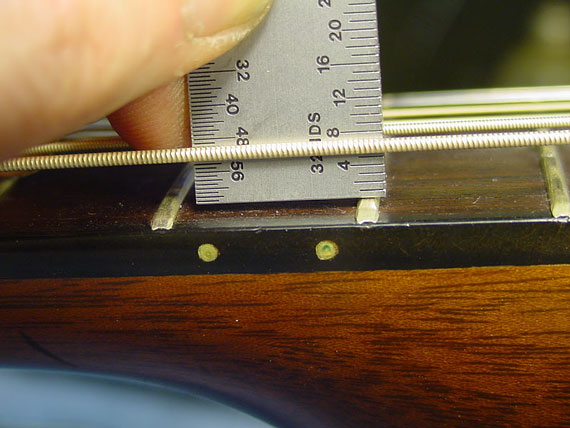
The feeler gauge is another inexpensive tool widely available at hardware and motor stores. It is useful while measuring action at various points on the fretboard and other such.
A good quality 6-inch ruler, preferably steel, which is calibrated clearly, will always come handy.
A COUPLE OF TIPS
You have put in new strings and as you are tuning up the instrument, there is a sharp ‘thud’ and the string that you had been tensioning, suddenly goes slack.
A look underneath the bridge. (pic courtesy TDPRI.com)
Ideally, the ball ends of your strings should sit like these above, except for the 3rd string from the right. That is the position of the string just before you hear that ‘thud’. When you start tuning the string, the ball end caught on the bridgepin is released and it hits the bridgeplate with a ‘thud’.
Nothing wrong with the phenomenon but continued occurrence can lead to substantial damage to the bridgeplate.
An example of the damage the ball ends of strings can do to your bridgeplate.
To avoid the situation, here are a couple of tips, and though these are two, they are inter-connected.
Firstly, see that you bend the ball end of the strings like this.
This helps avoid the strings getting caught on the pin edge.
Also, shaving the bottom of the pin at a 40 – 45 degree angle ensures that the turned string end slips past the end of the pin and sits comfortably and easily against the bridgeplate.
This photograph was sent to me to see if I could rectify the problem. For the life of me I could not fathom what fungus could have caused the fretboard wood to lose its colour like this. I called the instrument in for closer inspection and when I saw it in person, I slapped my head at my own idiocy.
The fretboard wasn’t losing colour – well, in a way it was. The wood was light coloured and had been painted dark. As the paint flaked off, the natural colour of the wood was showing through.
With the owner’s permission, I decided to scrape the rest of the paint from the fretboard. A time-consuming process, it had to be done to keep the instrument presentable.
Once done, the natural beauty of the light-coloured wood shone through and made the instrument look much better.
What do you think?
Here is the guitar with the fretboard oiled and the frets polished.
The owner also wanted to change the tuning machines on the guitar as the original ones were a mix-and-match set, and some had even got twisted over time.
He wished to replace the originals with these ones.
Pretty, wouldn’t you say?
However, as expected, the holes for the screws did not match up. So, I filled up the original holes.
I drilled new holes and then installing the new tuning machines was just a matter of screwing them (pun unintended).
Nice?
While working on the instrument, I noticed that 40+ years of playing had taken a toll on it (It belonged to the owner’s mother, who used to play it as a younger woman!).
I decided to touch it up a bit and the result was not bad.
And look what fell out of the guitar while I was cleaning it from the inside…
At its sight, I shrank as if I was staring at a King Cobra! This was not good, not good at all. Wonder how long it had been living there and what it had done to the wood.
The owner had also provided a new set of very jazzy black nylon strings to be put on the instrument. As I put them on and began tensioning them, I heard weird groans, creaks and crackles. Those kind of sounds are only caused by the bridge lifting off the top. But I had checked the bridge earlier to see if it was lifting and it was stuck solidly to the top.
When I finally checked the guitar, the bridge had managed to rip the top in an effort to counter the tension of the strings. The silica gel had done its bit!
There was nothing that could be done except feel sad about the instrument and the owner. Maybe, just maybe, if I had tried humidifying the instrument for a couple of weeks when I saw the silica gel sachet, this would not have happened. And then again, that would have been a big ‘if’, for as I said, there was no knowing how long that sachet had been lying inside the guitar.
Naturally, it was a disappointed owner who came to pick up the guitar. My advice to him was to play it as much as the instrument would allow, and later, to hang it up on a wall as a showpiece.
My advice to you, my readers, never, NEVER, put silica gel or other desiccants inside acoustic guitars, especially classical guitars, for these are delicate instruments and do not have the brawn and muscle that flat-top, steel string instruments are lent.
This baby of a baby was brought to me with the complaint that the thinner strings were buzzing. A very pretty, all-mahogany, three-fourth size guitar, I was surprised to see major divets on the frets over which the ‘e’ and ‘b’ strings ran.
The surprise was due to the fact that the owner’s father informed me that it was a new guitar, bought from a shop locally, and the child had just started learning how to play it. Also, look carefully at the guitar and you will be able to spot the film still attached to the pickguard – a sure sign of the newness of the guitar. The divets, then, were a shocker.
The fretboard was very dry and a light scraping and oiling helped condition it back to prime health. But do look at the fretwire closest to you. Amazing!
Anyway, it had to be cured of its ills and so the fretwires across half the board were levelled and crowned to remove the huge pits in them, and then the fretwires were polished up to a decent shine.
The Mummy Returns: The fretboard taped-off and the fretwires levelled.After the crowning process.See how they shine!
I did point out to the owner the badly cut plastic nut but then I did not expect him to ask me to change it. It played well enough as it was, and for the child learning, it was good enough.
This li’l one was brought to me by a harried husband who had bought the ukulele online as a gift for his wife. It was a well-constructed, high-gloss instrument with solid spruce top, solid mahogany back and sides, and a rosewood fingerboard and bridge.
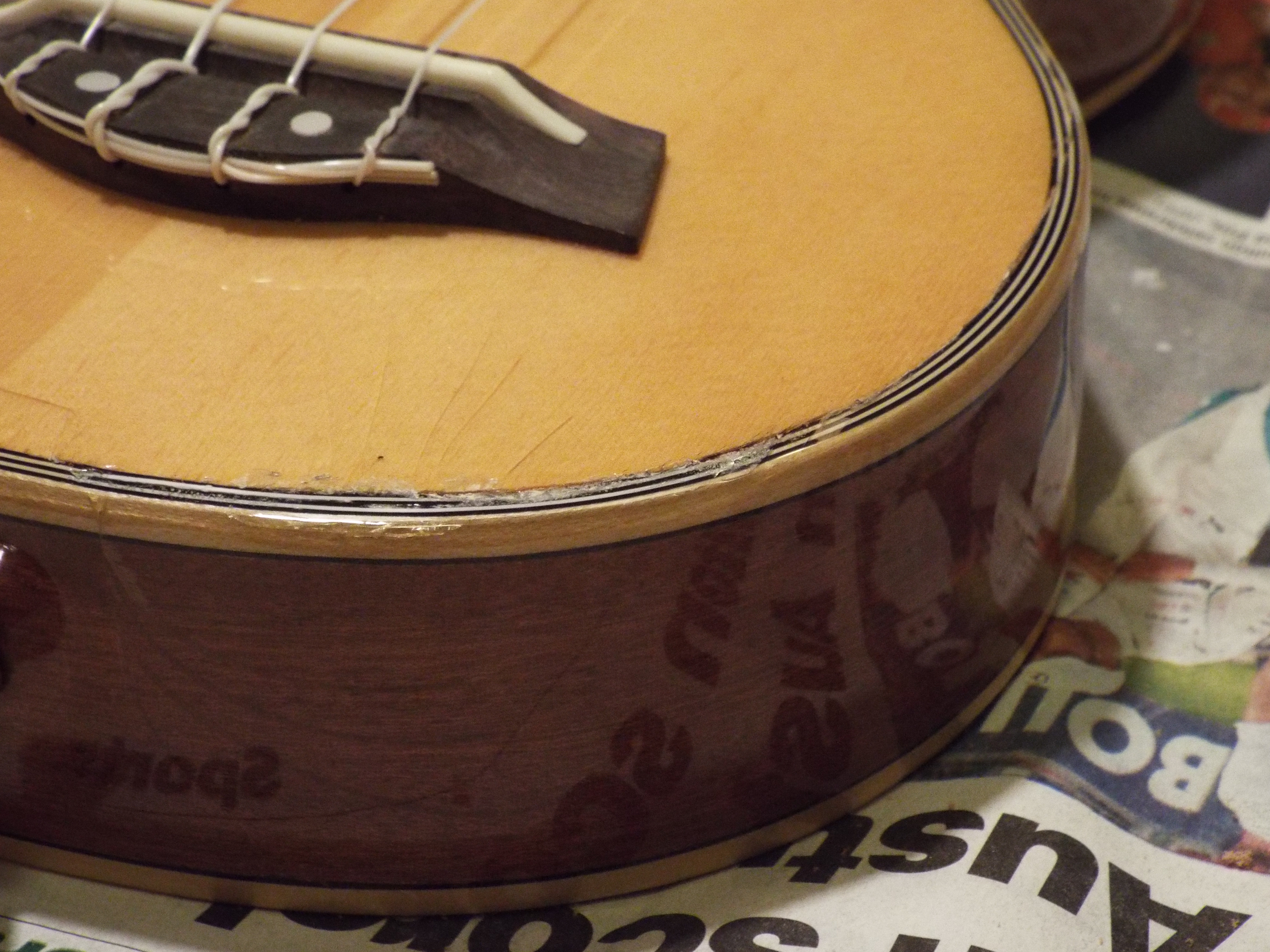
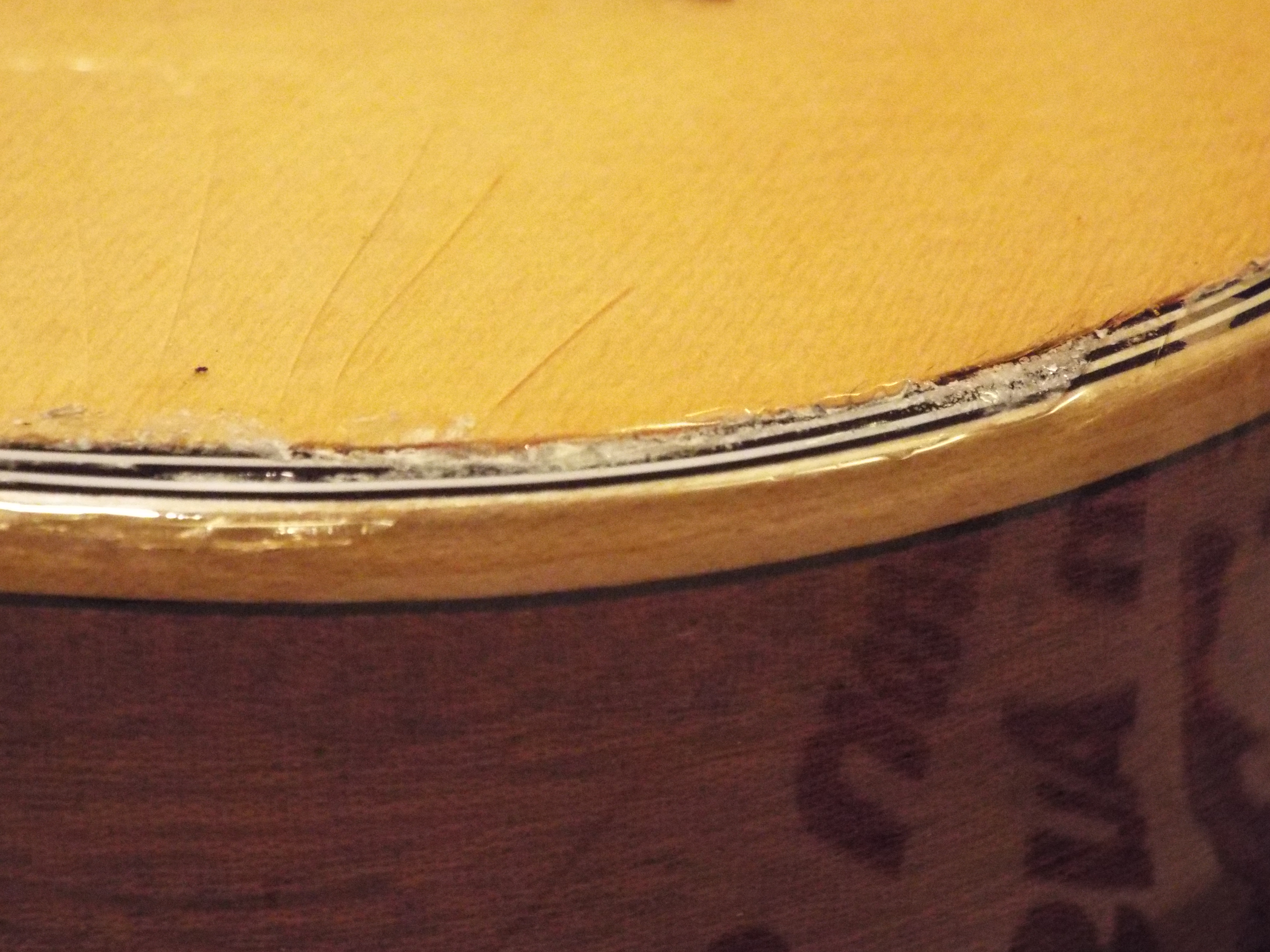
The problem – as was all too evident – was this trauma caused in transit.
Look carefully how the binding is raised and how the lacquer is cracked both on the top as well as near the end-pin of the instrument. It tells you that the force of the impact was along the side of the instrument – probably on the end-pin itself. Consequently, the side had got pushed in, pushing out the binding and the top. Though the maximum damage was to this region, it extended till say midway to the lower bout.
No matter how much I pushed and pulled, the side refused to move out and the top refused to be pushed in. Thankfully though, the binding could readily be seated in its slot.
With the binding seated, I sanded lightly along the edge of the top and finally, after many attempts, got the top to sink into place.
Then began a long and slow process of filling in the missing lacquer with three grades of super glue, wet sanding with three grades of sandpaper (grits 3000, 4000 and 6000) and then buffing and polishing the instrument.
My worse-than-amateurish photography skills do not do justice to the finished product.
So, humidity is important. And how do you get it into your instrument – humidifiers. There are as many type of humidifiers as there are guitar models.
This one too hangs into the soundhole while resting on the stringsThis one lies in the body of the guitar while the plastic cover lies over the soundhole, stopping the moisture from escaping, retaining it within the instrumentAnother soundhole humidifier
All of these work but they are expensive. What if you can get a bigger bang for a smaller buck?
Take a look at my favourite humidifier.
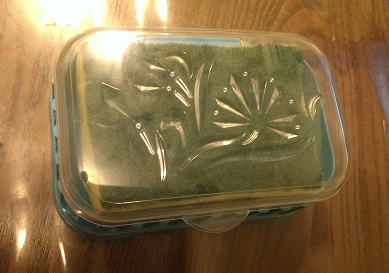
Do you recognise this?The humble kitchen scrub in a soapdish is the perfect humidifier
You can save still more if you replace the soapdish with a zip-lock bag punctured in places to let out the moisture.
All that you need to do is to soak the sponge, leaving it just moist enough – as opposed to being dripping wet – and leave it inside the body of your guitar. If you want, you may cover the soundhole with a lid of sorts.
Check the moistness of your sponge every few days and when you find that the sponge is almost as wet as when you placed it inside, rest assured that your instrument has had enough to ‘drink’.
But if you wish to be 100% sure, use this:
A digital hygrometreAnother version with a temperature reading
A digital hygrometre is a wonderful instrument: cheap and reliable. You slip one of these through the soundhole of the instrument and leave it there for a few days. To get a very accurate reading, cover the soundhole of the instrument with a lid. After a few days, the reading that you get on your hygrometre, is the humidity in your guitar.
NEVER keep both the humidifier and the hygrometre in the instrument together, for the hygrometre will keep reading the humidity content of the humidifier!!!


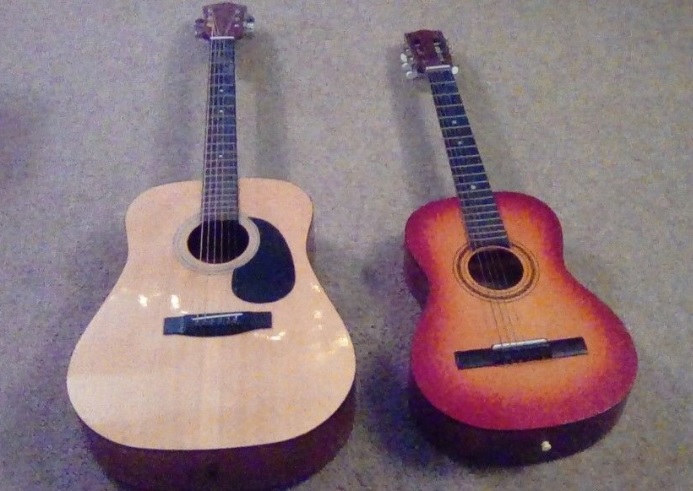






 C’mon! Look at that beautiful sunburst!Think about it till Sunday, when we get into the business side of things.


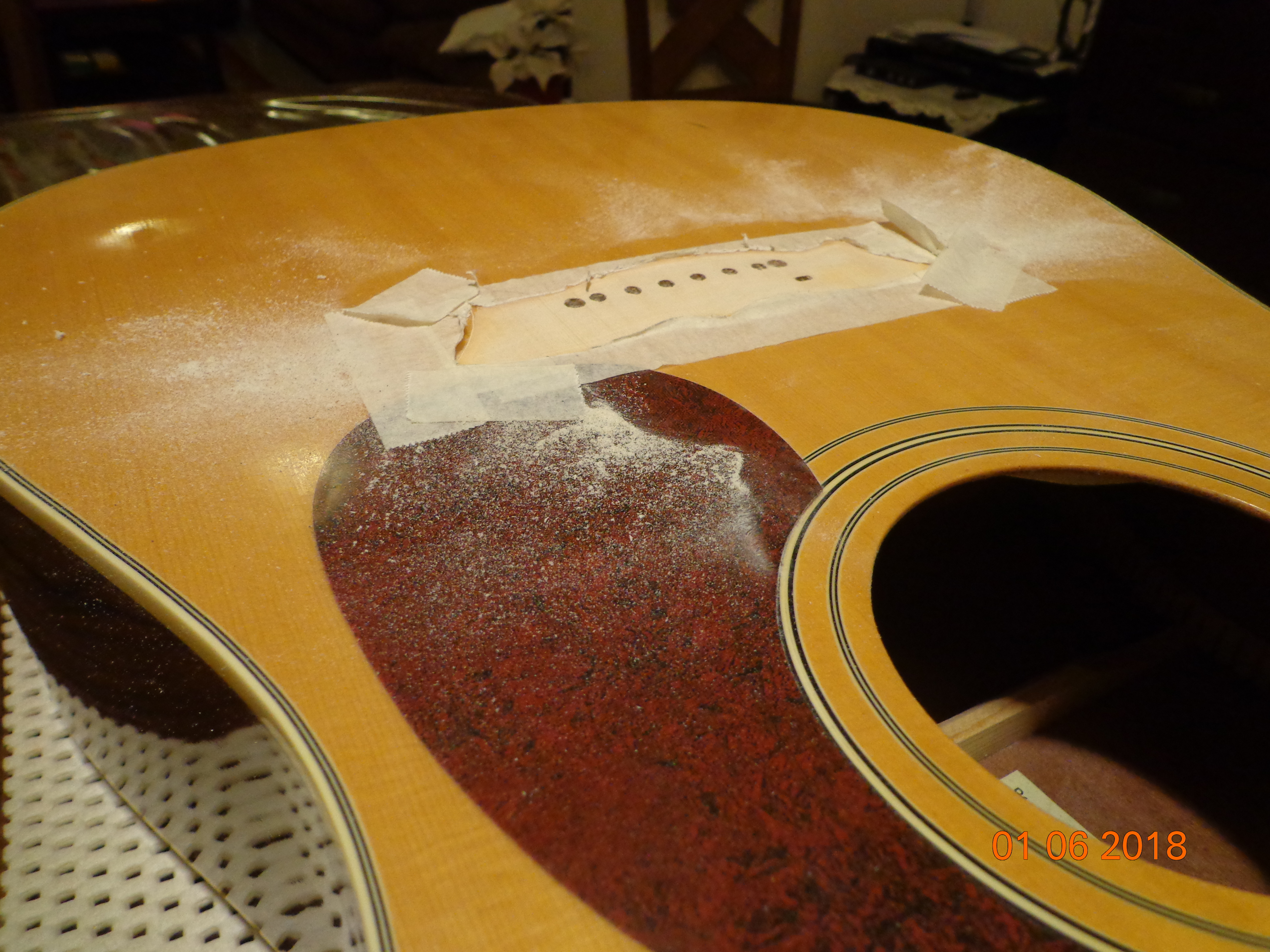




 One look at it and I was grimacing for I knew what lay ahead: hours of scraping and scratching and cleaning before it was completely rid of the goo. Exactly two hours and forty-five minutes later, the bridge and the area on the top where it would be stuck, looked like this – finally!
 I glued on the bridge and clamped it down to be left for 48 hours like that. In the meantime, I went about working on the dented fretwires.