Black Beauty gets a new saddle (and nut)

Black Beauty came in the other day, looking rather in bad shape, and needing some serious TLC. Its coat too had not been rubbed down in a while and was dusty, dirty and dank, and with enough scratches on it to rechristen it ‘Scratchy’! Of course, The Guitar Garage is just the place for getting all the love and attention that every instrument deserves.

The complaint was that the first string was buzzing, and as the eye automatically went to the problem areas – the saddle and the nut – I was shocked to find tissue paper stuck under the high ‘e’ string, where the saddle should have been. As I looked askance at the owner, he said that the saddle had got chipped in a fall and so he had stuck some tissue to help the string to ride the saddle better!

Doctoring the saddle is never a good idea (1)

Apologies for the shaky shot, but I was literally shaking in anger at the presumed ingenuity of the owner.

IMG-20180324-WA0008

FOOLED YA!!!! I do have another, clearer shot!

But jokes aside…PLEASE…don’t just try stuff…there’s a load of information available over the internet, rummage through it, you will be none the worse, and what’s more, your instrument will thank you for it.

The strings needed to be changed too, dirty and gunky as they were. So, off came the strings, and as they did, what did I see:

Does your fretboard have enough DNA to write your family tree (5)

enough DNA reserves that had the ability to map the owner’s family tree!

Does your fretboard have enough DNA to write your family tree (6)

Does your fretboard resemble this? If it does, when you take off the strings the next time to change them, please make a little effort, take a wad of ‘0000’ steel wool (available at most supermarkets and corner stores) give your fretboard a thorough rub down – right from the 1st fret to the last one on the fretboard extension over the top – and see your frets and fretboard gleam like new.

But as I looked and pondered a formal chastisement of the owner, what did I see, but royal divots, from the very first fretwire (Yes! the space between the fretwires is the ‘fret’, not the wires themselves, as people erroneously refer to them), to say, the 8th or the 9th fret in the area in which the ‘e’ and ‘B’ (the two thinnest) strings would float.

Royal divets

And so, followed the painfully slow and painstaking process of levelling, crowning and polishing the frets to take out the gouges in the fretwire. Two hours later, I was hot, perspiring and panting, but satisfied: the fretwires were done.

Frets levelled (7)
The fretwires captured before getting crowned and polished

But as I went about the chore, what did I see: Do you see it too? Look closer at the high ‘e’ area of the nut. MORE TISSUE PAPER!!!!!!!!
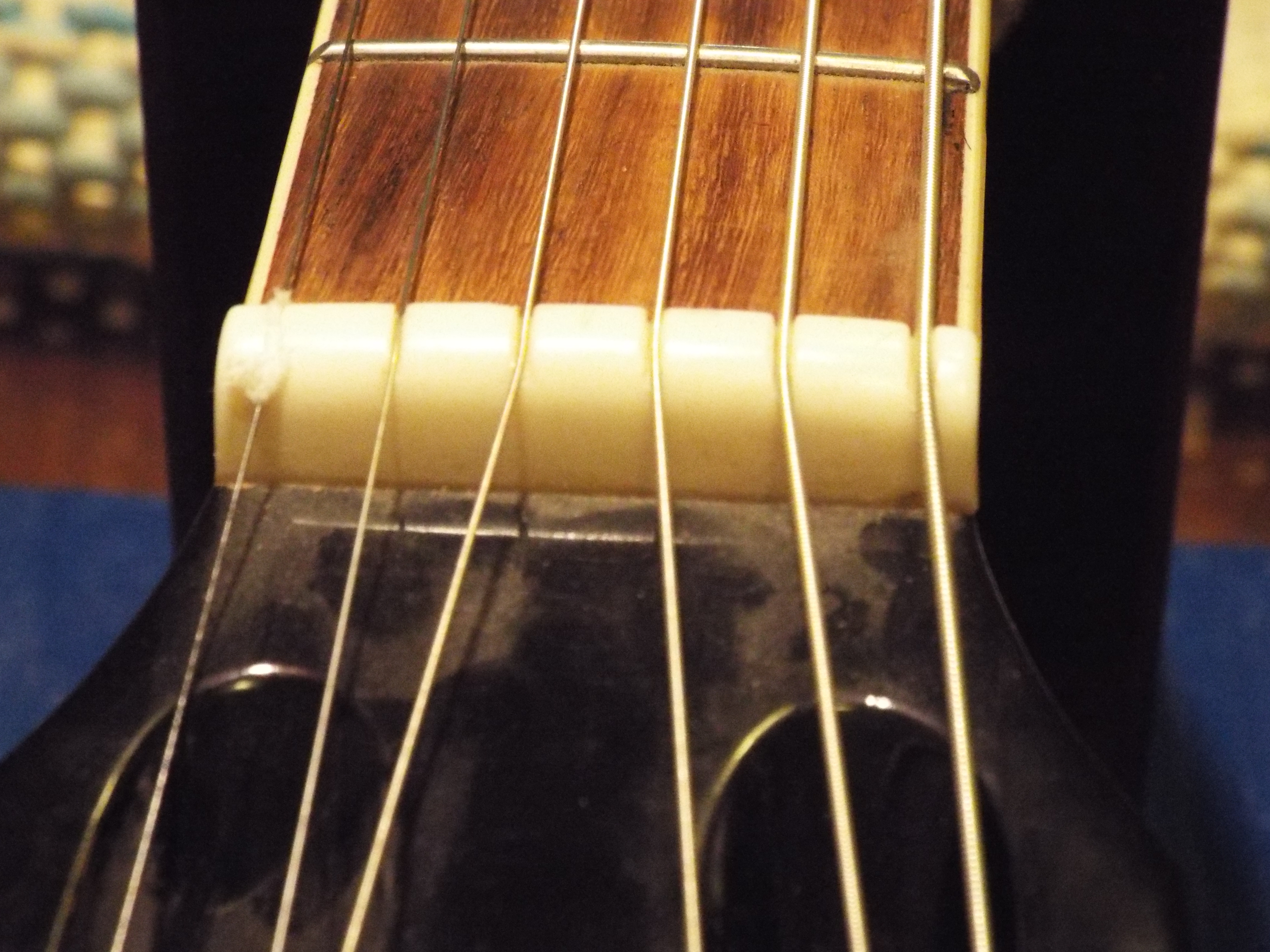
Exactly what the nut of your guitar should not look like (3)

The more I thought, the more I was convinced that this man got his tissue paper for free!

Also, how deeply the strings sat in the nut slot was worrisome to me. Your strings should never sit more than half their circumference in their nut slots – the three thickest ones at least.

Once the fretwires had been taken care of, pulling out the saddle and the nut was a simple process. While the originals were cheap plastic elements, I replaced them with bone elements which would last much longer and lend greater volume and sustain to the instrument.

With some elbow grease put into rubbing down of Black Beauty’s coat, she looked truly resplendent! Wouldn’t you say so?

A new, handsome saddle sits smart in the bridge (2)

With a new compensated saddle installed

With the new nut things start to look up (4)
A new nut in place

El Classico had a great fall!

A very common acoustic guitar affliction is it tipping over, and the headstock cracking, or breaking, or the neck cracking or breaking. 99% of the times, carelessness on the part of the owner, is the reason for the damage – both to the instrument as well as to the pocket. The funny part is no owner is willing

El Classico had a great fall and broke his crown


to admit that it fell and broke.

In a month I see at least one such case in varying degrees of damage.

El Classico, here, came in looking in rather bad shape. The first order of service was, of course, taking off the hardware to be able to reach the problem area. The problem is compounded when the break has an open end: the crack has broken off clean at one end. Thankfully, this crack was joined at both ends but a bad crack nonetheless. Pressed together, the sides of the crack refused to align.

El Classico - another view

What’s more, for a good repair, I needed the nut out of the way so that I could clamp down that lifting end and make it a seamless joint. But you just can’t ‘lift’ out nuts, the way you lift out saddles. Nuts are knocked out of their groove. However, knocking this nut out would mean more damage to the already lifted edge.

After much head-scratching and chin-stroking, I decided to tap the nut out from the side. With gentle repetitive taps with a hammer to a padded screwdriver end butted up against the nut, I managed to dislodge it.

Then began the slow and arduous process of dry runs to see how the misaligned sides of the crack could best be brought together. More knitted brows followed as I tried this and that and more.

Half-an-hour later I finally had it together. Glued, clamped, it stood there for 48 hours before I released it.

El Classico - in the operation theatre

Providentially, I had just acquired these small C-clamps recently, and specifically to tend to headstock and neck repairs. This online order came just a few days before this Yamaha arrived at my doorstep.

El Classico - sutured and bandaged
Another view of the neurosurgery on the Yamaha.

After 48 hours, when I did release it from the clamps that held its head together, so happy was I with the results that I forgot to take photographs. Some light wet sanding later, it looked the best that it could have.

The owner, when he came to collect the instrument, concurred with my view.


Choosing a guitar

An acoustic instrument’s sound is due to the wonder of material used to build it and is never dependent on electronics – not even in electro-acoustic instruments.

Thus, I always advise beginners and others wishing to purchase an instrument to blindfold themselves and see with their ears! You go into a shop and even as you are glancing over instruments, your eyes will stop over one or two instruments. Believe me when I tell you that you have already chosen the guitar to purchase! Such is the power of vision that it overpowers all other senses, and so, blindfolding yourself takes sight out of the equation.

It is actually a very simple process. Go to the shop with a friend, sibling or spouse and ask them to blindfold you before you enter the shop. Sit down and give the salesperson a price range in which to show you instruments.

Of all the instruments that the salesperson shows you, some will have a bell-like clarity (due to the highly accented treble range), some will have a drum-like booming quality (due to the accented bass range), while still others will be a very happy blend of the two. So, which one should you choose? Let me take the mystery out of the choice-making and tell you that there is no ‘right’ or ‘wrong’ sound. Whatever appeals to your ears is the right sound.

So, choose the three best instruments that your ears pick up for you and have them kept aside. Now, go over the other guitars once more. Choose the best-sounding instrument from the ‘rejected’ lot and have it kept along with ‘the chosen ones’. It is time now to take your blindfold off and actually see what you have chosen.

Of the four guitars on show, you will reject at least two for one reason or another (that’s the way the human brain functions). The remaining two, pick them up and play them, looking for exactly what made your ears choose it.

Once you have made your choice, go through the instrument with a fine-tooth comb.

Here is a list of things to look for:

  • Is it a solid wood instrument or is it made from laminated wood (layers of woods)? A solid wood instrument will be costlier but the sound quality will be appreciably better than that of a laminated wood instrument. If you are unsure, ask the salesperson.
  • colour inconsistency, if it is a painted guitar
  • Scratches, dents, dings in the finish. Give the neck of the guitar a proper once over both with your eyes and fingers because that is the area where your hands will stay the maximum amount of time.
  • Take a piece of paper and try pushing it under the bridge, under fretboard extension that is stuck to the top of the guitar, and at the joint where the neck heel is stuck to the body of the guitar. No more than 1 cm of a corner of the paper should go under any of these three places. If it does, reject the instrument outright.
  • Check the tuning machines for extra play/looseness. These can give you tuning nightmares later on. Have the salesperson tighten them.
  • If there are electronics on board, plug in and play away. Check that the pick-up system is ‘picking up’ all the strings by playing each string individually.

Once you have made your choice, don’t forget to buy a semi-hard or a hard case to go along. It’s like buying a helmet when you buy a motorcycle!

Debunking a few myths

1) I am learning to play so I don’t need to spend so much.

You buy a guitar only once. Buy good. If you must, wait another six months and buy the better instrument.

2) That child will grow up fast; the guitar will never

Initially, six-year-olds will look odd holding an instrument much larger than themselves, but children grow up faster than you think. Don’t make the mistake of buying a small guitar and later not knowing what to do with it. Besides, when children play a full-size instrument, it forces them to stretch the fingers on their fretting hand. Consequently, they learn to ‘get there’ faster than they would have if they had been playing a small-size instrument.

3) This guitar is old and looks used.

If it is a solid wood guitar, or even if it has a solid wood top, chances are that it will have a sound so beautiful that you will fall in love with it. Sound is produced when the top vibrates and pushes the air out of the soundhole of the guitar. The more the top vibrates, the bigger will be the sound. Additionally, the more the guitar is played the more the top moves and gets used to moving. Thus, a used guitar would be my choice of instrument. Don’t trust me? Check out the prices of guitars made in the 60s, 50s, or even in the 40s or 30s!

This should give you a clearer picture.

pg7_C1sep16

Happy choosing!

Acoustic Guitar

What is a set-up? Why is it needed?

If there is one thing and JUST ONE THING that you should get done in your acoustic guitar, it should be a set-up. A set-up is required so that the instrument can play properly and easily, the best that it can. It usually includes adjustments to the saddle, nut, truss rod, adjusting action, adjusting neck relief (yes, the last two are separate jobs and different things to serve separate ends) checking and tightening of hardware, conditioning the fretboard and the bridge and, of course, intonation. All of this is done, keeping in mind the playing style of a guitarist.

The instrument of a finger-style player, with a light touch, will be set up dramatically different from, say, a country balladeer, who plays with a heavy hand and demands a lot of volume from his acoustic guitar.

Why is a set-up required? It’s like you saved and you spent big bucks on the guitar of your dreams, but without a customised set-up, created specifically for the way you play, it’s been a waste of time and money.

Mass produced as they are, guitars are not generally set-up at the factory, or in the showroom. My advice to youngsters and people who are contemplating purchasing a guitar is to have it set-up right after they make a purchase. That way, the guitar plays perfectly to their particular style and technique. A guitar that is properly set up is a real joy to play.

Even if you already own a guitar and have been playing for years, it is never too late to get your guitar set up . The difference that a ‘good’ set-up makes can only be experienced.

COME…experience that joy!