Another Cort, more intonation issues!

Two in two weeks! Two Corts, different models, same problem, same owner! Fancy that!

So, this week I have for you this

The owner told me about the intonation problem and again I looked straight at the saddle. That seemed fine, as did the nut, though regular wear and tear had caused the strings to sit far deeper in their slots than I would have liked.

I decided to change the nut and saddle, use bone, in the hope that the intonation on the instrument would get sorted with new, harder stuff.

So, I cleaned out the nut slot, cleaned and oiled the fretboard, gave the fretwires a good rub.

Then I turned my attention to the nut and saddle. Some measurements and more shaving ensured that I got the saddle and nut to the dimensions I wanted them in. Both sat as snug as a bug in a rug.

However, when I strung up the instrument and checked the intonation, it was off by some distance. Again I pulled out my trusted file and went to work on the saddle. After much tweaking, the instrument intonated to within permissible limits.

Cleaned, polished and strung up, this too was a beautiful instrument.

The abalone binding along the top and around the soundhole, did really make it look special.


UPDATE: The owner has called to say that the action on the instrument has risen and he will be bringing it in for me to take a look at.
I am keeping my fingers crossed! 


This Cort petite wonder with giant intonation problems!

I have seen enough Cort guitars to be convinced that the company employs interior designers rather than luthiers to build their instruments! The instruments are extremely high on aesthetics and visual appeal, and by comparison, very average, when it comes to performance.

Take a look at some of the appointments on this little body guitar that came to me recently.

  • open-back butterbean ‘GROVER’ tuners with a ratio of 1:18. Though the tuning machines proudly proclaim ‘Grover’, I am not very sure if it is the same company. Why I doubt they were Grovers is because the real ones would never have their coating peel like these ones in just five or six years. 50 or 60 years, maybe!  

  • lovely two-piece solid Mahogany back (and sides) with a rope-design binding in between

  • celluloid tortoise shell-bound headstock and fretboard (it actually lit up each time it caught the light).  You want more?

It had a beautiful Venetian cutaway, a Fishman Presys – Sonicore pickup on board and a solid Red Cedar top.

This instrument was a L500F NAT, a model which the company has since discontinued (I tried searching for it on the Cort site but could not find it). Small of body, I guessed that it was more of a finger-stylist’s instrument of choice.

Wonder of wonders, it belonged to an accomplished performing/recording artist, capable of creating magic with it through his fingers.

His complaint was that the guitar had very poor intonation. As soon as he said that, my eyes went to the saddle.

Can you see the problem? Let me amplify the image a bit.

Do you see it now? That piece of paper stuck in front of the saddle meant that the saddle was falling over: too thin for the slot. Yeah! Sure enough!


I told the young man that I will change the saddle and nut, put in bone elements and everything would be fine. 

Later, as I went about working on the instrument, I pulled out the saddle, lifted the piezo element, and…

…I could have jumped as if I had seen a snake hiding under it. I tell you, the logic of it beats me completely. You use a piece of plastic for a saddle and that too you need to shim up with whatever you can lay your hands on???

As I gave the instrument a once over, I noticed that the first five fretwires were a bit munched.

I started from here. I ‘mummified’ the first six frets 

smoothed out the first five fretwires, threw in a new bone saddle and nut cleaned up the guitar and…I have no photographs to show!!!

Somehow, the memory card on my phone went on the blink and never captured any of the following photos!

With the new bone saddle in place, I checked the intonation, but strangely, it was more than a few cents off. I’ve never had that problem with a saddle that I replaced, and now that I was encountering it, it meant just one thing: the bridge was not in the right place.

What had to be done then, was to manually file the saddle and get the intonation within a couple of cents of acceptable limits.


Negligible fretwire munch, massive fretboard munch!

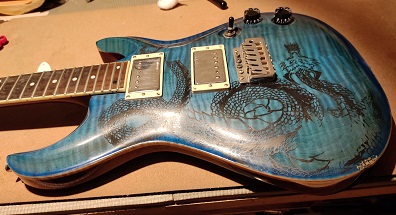
This pretty Cort electric landed on my counter recently. It was a lovely flamed-maple top, painted aquamarine.

If that wasn’t enough, someone had painted an exquisitely detailed dragon on it in acrylic paint, raising the prettiness quotient many times over. That being said, it is also true that in the face of such efforts, deep-cleaning of the instrument becomes near impossible, or one risks erasing someone’s creativity.

Thus, we would have to make do with just brushing off the dust from recesses and corners.

Over the phone, the owner said that he wanted me to work on the fretwires as he had much difficulty in bending notes. No problemo!

Also, there was a chip of paint and lacquer missing along the lower bout extremity on the bass side. He asked me if I could fill that too. I made it clear to him that filling up the missing lacquer won’t be that difficult but he shouldn’t expect that it would be an invisible fill. Lacquer dries and shrinks at its own pace, bringing to nought the best colour-match efforts.

But first the fretwires.

The first picture is of fretwires 1 to 5, while the second photograph captures fretwires further up the neck (sorry for the crappy pix!). In the captures, you can see very minor divots on the fretwires. What else do you see?

I’ll tell you what I saw. The surface of the fretboard was as if a naughty dog had played fetch over not-so-dry cement. Electric or acoustic, I had never seen a fretboard that chewed up. What’s more, it was nothing like the marks usually caused by nails digging into the fretboard, but there were strange undulations in the wood. Try and picture a molten metal fretboard that was shaken in the process of cooling. The wood on this fretboard looked something like that.

I spent an hour scraping and scratching before I could somewhat level the fretboard. Even then, not all of the ‘craters’ could be completely removed. 

Levelling, crowning and polishing of the fretwires was carried out in that order. But first, the fretboard had to be ‘mummified’!

Seven grits of sandpaper, some chrome polish, a little help from my friend

and after the first few passes the fretwires looked like this

Another hour later, the board looked sharp and ready for some slides, some plunges and some bends.

When the owner came to pick up the guitar, I caught hold of his fretting hand and checked his nails (I actually did!!). Believe it or not, if the nails had been any shorter, he would be missing a digit on each of the four fingers of his left hand!

As far as the chip in the paint was concerned, the surge in Covid-19 cases has ensured that the owner stays holed up in his house, as I do in mine. But that is a job to be done: watch out for it.


(What is that symbol? Infinity? Ex?) A little help in the nick of time!

Just a quick one this week to keep your mind off everything going on around us – for a little while at least!

I have often made my distaste apparent about locally made instruments selling in the range of Rs 3.5 – 5.5K. However, I have also said that there are exceptions to my generalisation. I see them often enough: laminate guitars, unheard names, but they look alright and play alright.

One such instrument came to me recently with the youngster who brought it complaining of how the action of the instrument was increasing steadily. Alarm bells go off in my head as soon as I hear that and sure enough, as I checked, I found that the bridge on the instrument was lifting.

That is just a little slip of paper and the mark on it tells you how much it goes under the bridge at that point. That was approximately the average right along the bridge.

Also, in the photograph above, I wonder if you will be able to make out, the saddle is trying to fall over: a sure sign that the saddle slot is much broader than the saddle itself.

So, the first job was to try and see if I could get glue under the bridge without having to take the bridge off completely. Of course, the proper way to do it would have been to take off the bridge, clean the two mating surfaces and then glue the bridge back on. But that is serious money.

So that it was easy on the youngster, I decided to try pushing glue underneath the bridge. But this method is a hit-and-miss thing: it could work, or it may come apart in a couple of months, at which point the original method would need to be employed (thus, causing double the damage to the pocket). Here is the baby, all glued and clamped.

And, of course, something needed to be done about the tilting saddle. Why not throw it and the nut out and replace them with bone elements? Sure!

But as I pulled out the saddle, I saw something.

Yeah that plastic strip was hiding under the saddle.

Measuring the saddle, I had this much to take off

The nut, however, seemed to sit in its slot just fine (longer by a hair though).

That done, I turned my attention to the tuning machines. I tightened them and then gave them a rub with some ‘love potion’!

They turned out like this

And before I strung this baby up, I shaved the bridgepins some (stops the ball-ends of strings for catching on the ends).


This pickguard – genius, or, what was I thinking?

So, I had this young man come in, wanting me to take a look at his guitar, if everything was alright. It was a pretty looking (though dusty) Hertz with many aesthetic appointments.

For one, the back on the instrument had some very pretty, figured rosewood type wood on the outside.

The heel cap, too, was very pretty, different from what I had ever seen; spruce from the looks of it.

And that arm bevel…

Ah, well!!!

The owner brought it in because he was a little worried about this glue-up job and whether it would hold.

The glue-up job seemed to be holding and it was a  good fix. So, I told the owner to rest his head and not worry about it too much.

But as I turned the guitar over, I saw this

The first two photographs show dents possibly caused by fingernails in the process of percussive playing. The third photograph was cause for concern: pick or nail marks. Given enough time, the owner could easily slice through the soft, spruce. So, I told him that the instrument would need a pickguard, and he agreed with my suggestion.

In all the three photographs, do go back and admire the lovely soundhole rosette – another of those very aesthetic appointments.

Now, contrast all those lovely features that I pointed out, to this

Notice that the bridge is ‘painted’ a lovely dark brown. The real colour of the wood used is what you see on the walls of the bridgepin holes and the the empty saddle slot!

Also, the areas marked red looked as if someone had put plugs on the bridge. Plugs? Why? And then it struck me. As I went inside the guitar’s body, I saw it. I tried clicking a photo so that I could show you too, but, silly me, I did not clean the mirror.

Exactly where you can see dust on the mirror (the encircled area), is a length of screw hanging down from the top. There was its twin hanging just like it from the opposite end of the bridge.

No one, NO ONE…can convince me about the utility of these screws. On the other hand, I am sure I can persuade anyone on the disadvantages of having these on the bridges of acoustic instruments.

What was more, the bridge was beginning to show the initial cracks at the ‘G’ and ‘B’ bridgepin holes. I stuffed them with sawdust and wood glue and sanded everything smooth.

Needless to say that I also swapped the plastic/micarta/whatever nut and saddle with bone elements (not documenting it here; you’ve seen me do it a million times).

Thereafter, the fretboard and the fretwires were given some love and some love potion. See how it shines? And yes, that’s the new nut seated proudly in the slot.

However, the main job was fashioning a pickguard for the instrument. I showed the owner many designs and pickguard materials. He chose this one

And here begins the story of a strange happening. As you can probably make out from the photograph above, I had traced out the shape of the pickguard on the material and was about to cut it. Then, just like it happens in the films – eyes turning in their sockets and things happening on their own – I went blank, completely blank! I have no recollection of what transpired.

When I ‘awoke’, the pickguard was done, dusted and stuck to the guitar like this

My first reaction was to let out a shriek of horror. After that a lot of head-scratching followed to figure out how what had happened, happened (It was afternoon, and no, I hadn’t been drinking!). This was a month or so ago, and even as I write this, my brows are furrowed and I am still trying to figure things out.

‘Ah! What the hell,’ I had thought to myself…’if he doesn’t like it, I’ll have to rip it off and create another pickguard’.

But thankfully, the owner was very cool about it and, in fact, liked the ‘different’ design!

Whew!!!!!!!!!!!