A bridge too far…from the top!

1

This pretty guitar with an equally pretty bridge of nicely figured rosewood came to me looking like this. The gap between the bridge and the top was big enough to let you drive through a truck and must have resulted when the owner left it standing for months with the strings in full tension.

A word of caution here: if you know that you won’t be playing your guitar for a few weeks, PLEASE loosen your guitar strings. It takes away the stress the strings put on the bridge, on the crucial neck-to-body joint, the neck itself, and stops the guitar top from bellying up behind the bridge. Basically, loosening your instrument’s strings is good all round.

Besides, this instrument had a few other problems but none as major as the lifting bridge. The cheap plastic strap-pin was falling off, the fretwires and the chrome hardware was tarnished and needed burnishing, a fresh set of strings was needed, and the plastic nut and saddle needed to be replaced with bone elements. However, the owner did not wish to replace the nut and saddle.

2

3

When I began removing the bridge, it offered little resistance and popped right off. But what I saw underneath left me wide-eyed.

5

6

There was a disconcerting shine on the top where the bridge sat, as well as under the bridge, and as I took a closer look, it seemed as if the manufacturers had tried to save money on the glue. It appeared as if the entire top had been sprayed with lacquer (varnish) and while the lacquer was still wet, the bridge had been placed and pressed in, in the hope that as the lacquer dried, it would work as a glue. All this is pure conjecture on my part, but to be very frank, there were few traces of glue both on the bridge as well as on its footprint on the top.

Now, granted that this was not a famous brand name, but it was a very well constructed instrument with good wood used in it. Why somebody would go through all the trouble of selecting good material and make an excellent instrument and scrimp on glue, beat me.

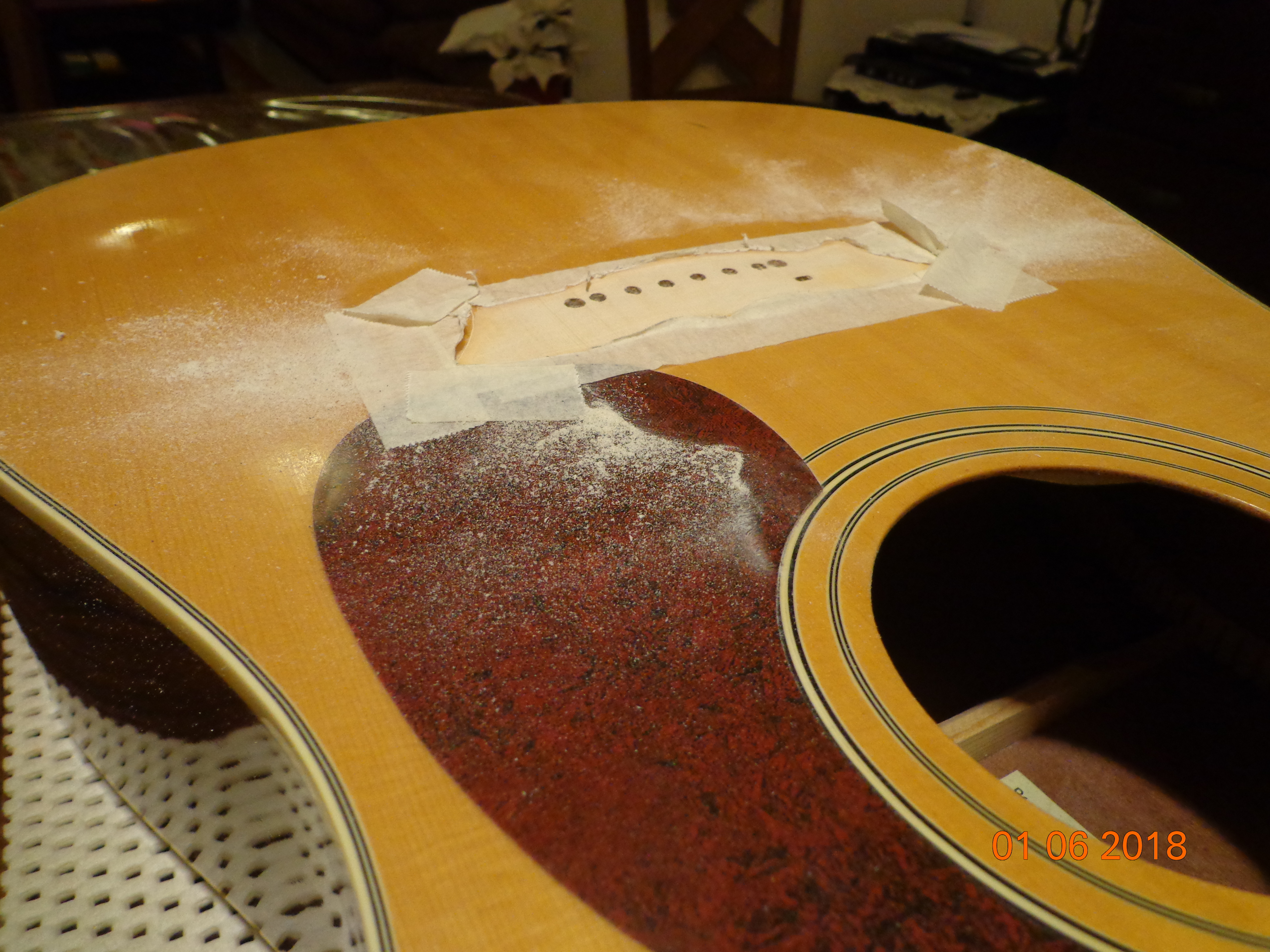
Whatever! My job was cut out – or, rather – gouge out all the glue. A painfully slow process, I scraped, filed and sanded close to three hours to get all the lacquer off from underneath the bridge and the top. Here’s proof:

7

8

When I finally sat down, perspiring and hot, the sight in front of me was indeed heartening.

9

10

Clean, wholesome wood shone through. Do appreciate the highly figured rosewood used for making the bridge.

Cleaning the two surfaces to be joined thoroughly, I applied glue, brought the two together, clamped them up good, and left the joint to cure for almost two days.

While the glue was curing, I worked on the fretwires and hardware of the instrument, giving it some polishing cream, some TLC and lots of elbow grease.

11

12

Just look at them shine!

13

The fretboard oiled and nourished, and the fretwires burnished and shining like new.

14

The clamps came off and with a good polish of the body the guitar shone with new light, with new strings completing the picture.  Do notice the shiny new strap-pin. Its twin sits as snugly on the side of the cutaway.

A set-up…a new life

DSC01400

This Ovation look-alike came in for new strings and a general set-up. It was pretty much like Ovation down to the fiber bowl-shaped back.

DSC01404

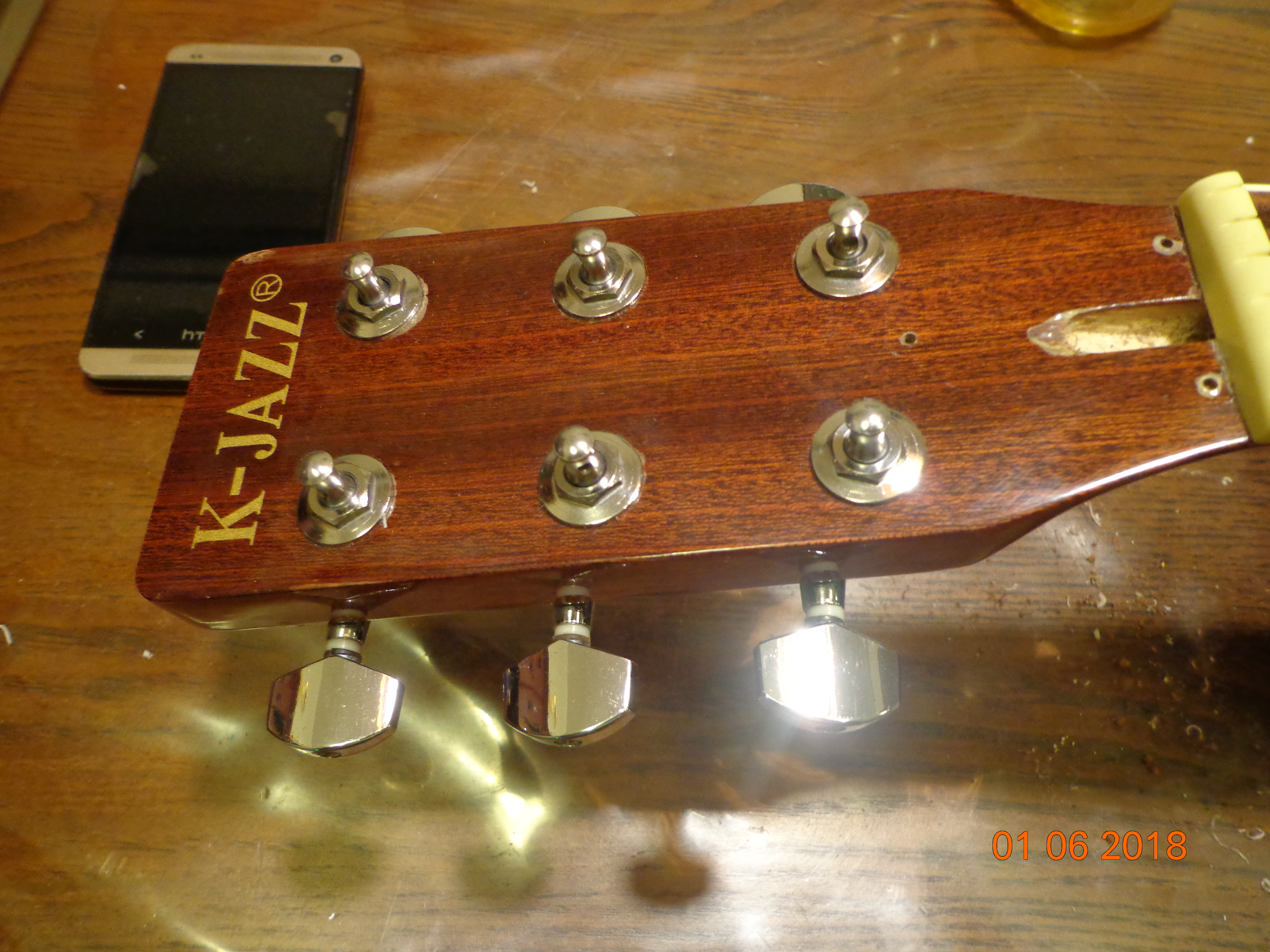
However, most amusing was the strings’ artwork on the headstock.

DSC01398

The extra length of the strings needs to be cut off for it is of no use and can only cause problems. And do notice how the D string tuning machine is bent at an angle.

DSC01405

The little screw holding the tuning machine had got bent and in doing so had bent itself out of its slot, creating a deep furrow. The only thing stopping the tuning machine from coming out of its slot was its nut on the front face of the headstock.

I took off the tuning machine and filled up the furrow and the screw slot with wood and glue. After the glue had dried, I re-drilled a hole in the proper place and replaced the old, bent screw with a new one. I also oiled, tightened and polished all the tuning machines.

Also, there were major divets in the first four fretwires and even though this is not a very clear photograph, I think you will be able to make them out.

IMG-20180529-WA0006

I had a chat with the owner about working on them and about replacing the cheap, plastic nut and saddle with bone elements. He agreed and I set about my job.

DSC01401

With a little love, some ‘0000’ steel wool, oiling and lots of elbow grease the fretboard and the fretwires were shining again.

The guitar looked and sounded better than it ever did!

Run, if you see your guitar tech doing this

action - thebasicsofguitar.blogspot.com
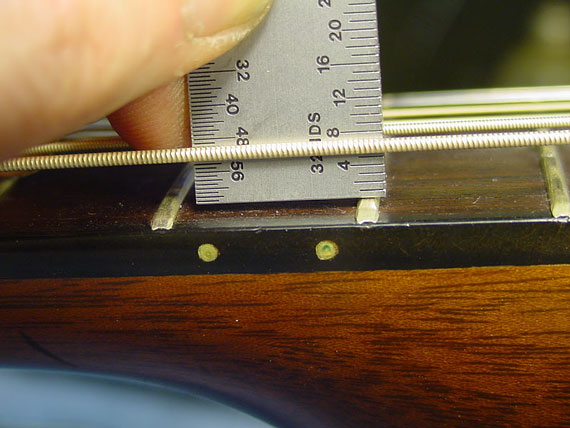
Measuring the action – thebasicsofguitar.blogspot.com

The action on your guitar is high and you take it to your technician to correct it. If he says it is a two-minute job, and picks up the hex key (Allen wrench), stop him then and there.

By picking up the hex key, what he intended to do, most probably, was to work the truss rod one way or the other. The truss rod is an iron rod with a hex nut on one end and sits in a groove in the neck, right under your fretboard/fingerboard. It can be accessed either through the soundhole, or from the headstock end.

where and how the rod sits - project electric guitar

trussrod as seen through the soundhole - tdpri.com
The trussrod end as seen through the soundhole – tdpri.com
thbecker.net
The truss rod with access from the headstock end of the guitar – thbecker.net

The purpose of the truss rod – in any guitar – is to dial in the right amount of relief (the string-to-fretwire gap) in the neck. IT IS NOT A PROCESS TO CORRECT ACTION, no matter what your tech or anyone else says.

sweetwater.com
Pic courtesy sweetwater.com

Why n when to adjust truss rod - www.talkbass.com

The right way to correct action on your instrument is a three-step process, correcting

a) action at the 12th fret (adjusting saddle height)

b) action at the 1st fret (adjusting the string slots in the nut), and

c) dialling in the right amount of relief in the neck.

I will discuss these in the next post with a set-up undertaken on a customer’s guitar.

This troubled Takamine!

This troubled six-string came in with the complaint that the action had got particularly high on it. During routine inspection it became clear why.

DSC013811
Apologies for the bad shot but this was the best among three or four that I took!

The bridge was lifting badly all round the end facing the end block. When a bridge lifts like this, the action is bound to increase, making playing the instrument a pain. In order to correct it, the bridge had to be taken off and reglued to the top.

But to be fair, this instrument was a mystery to me. The headstock read ‘Takamine’ (pronounced ta – ka – mee – nay), a respected Japanese brand founded in May, 1962, but the label inside the soundhole read:

DSC01389

‘Made in China’! Made in China??

Whatever!!!

I had a job to do and the quality or the make of an instrument should never be a concern, and it never is.

As I continued to inspect the guitar, I saw the usual things: plastic saddle and nut, grime collected over months of playing, huge divets in the fretwires, and of course, the instrument needed new strings.

DSC01383
The grime and the divets in the fretwires
DSC01384
Some more grime and the plastic nut

However, the biggest surprise awaited me when I took the bridge off. It popped off with little resistance but both the top of the guitar as well as the underside of the bridge were coated with an odd, shiny substance, which resembled varnish. Only, varnish can never function as glue!DSC01391DSC01393DSC01392One look at it and I was grimacing for I knew what lay ahead: hours of scraping and scratching and cleaning before it was completely rid of the goo. Exactly two hours and forty-five minutes later, the bridge and the area on the top where it would be stuck, looked like this – finally!DSC01395I glued on the bridge and clamped it down to be left for 48 hours like that. In the meantime, I went about working on the dented fretwires.
Only the first four or five needed attention and so I worked only on them, some financial respite for the customer.

Also, the plastic saddle and nut were replaced with bone elements that would not only last a lifetime but provide quality sound too.

Your guitar’s action has gone high…overnight!

action

Yes! It does happen!

You played your guitar the night before and when you pick it up in the morning, the action on the instrument is sky-high.

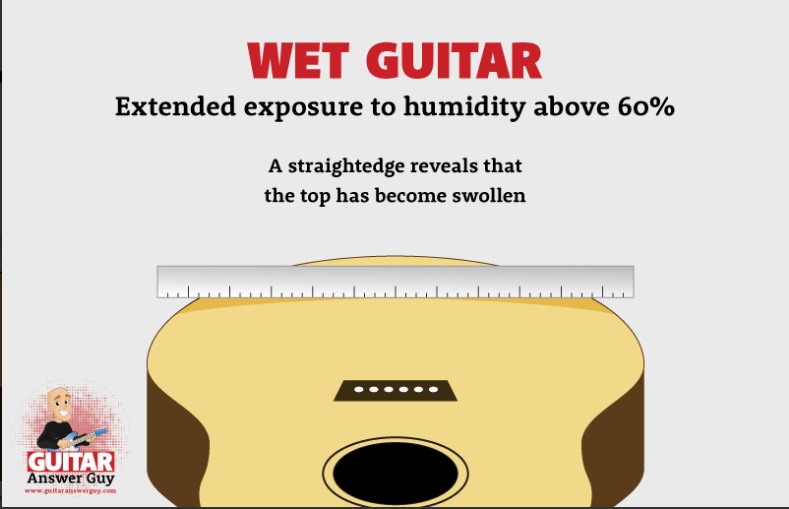
This happens more often than not due to humidity – too much humidity – which is not often discussed. It is also possible that the neck may have moved during the night, causing the strings to rise over the fretboard.

A friend had this very expensive guitar which he used to religiously humidify. In fact, when he used to return the instrument to its case,  there was a humidifier waiting there to feed it!

So, one fine day, when he picked up his instrument to play, he could hardly play it. Astounded, he checked everything and when he could not find the problem, rushed over to show it to me. Here is what I told him:

“When you are hungry, you eat, and you continue eating till you are full. What would happen if you continued to eat even after you were full?”

“I would bloat,” he said, still puzzled at where I was getting with me targeting his gastronomical proclivities.

“Exactly!” I said. “Your guitar has had too much to eat, or rather, too much to drink. The bloating is due to the fact that the wood in your instrument has taken in way too much water than it required. In fact, you can see it here”. And with that I took a 12″ ruler and laid it across the top just under the bridge. While the centre of the top was in contact with the ruler, the ends of the ruler were high in the air, just like this:

belly

My advice to him was to loosen the strings, take the humidifier out of the case and not to  humidify the instrument at least for three weeks.

My friend got back to me in two weeks to report that the instrument had lost its belly and the action too was back to normal. I asked him maintain the no-humidity regimen for a week more before he started humidifying his instrument again.

My next piece of advice to him is also the advice I give you.

“Of course, you must humidify your guitar but then you must know when your guitar has had enough to ‘drink’. You will only know this if you have a small but reliable hygrometer kept INSIDE the guitar itself. Having a humidifier in the case of the guitar will never give you a very accurate picture of the humidity level of your instrument.

hygro

This instrument might appear large but fits easily in your palm and also inside your guitar.

After every four or five days check the reading on it, and once your guitar reaches that optimum range (45% – 55%) of humidity, stop feeding it water.

Relatedly, the tension of the strings acting on the neck might cause it to bend one way or another. A simple, 1/4 turn of the truss rod should be enough to correct the problem.