Yama-ha-aa-aa-ha-ha-ha – the one that refused treatment

In all my years into guitar repair, I finally met the guitar that refused to be treated and was as obstinate as only it could be.

You will recall that I had put this F310 into three types of vices and for 14 days.

But, I am sorry to report that it spurned all my advances and its belly sprang back to where it was, as soon as I put on a single string.

You will also recall that I had decided to put on .010″ – .046″ (ultra light) strings but still…

Sadly, it left me with that awful belly that leaves the action a mile high. I didn’t even bother to measure it. You can see that in the photographs.

However, there is still one treatment that can be given, which will be like a permanent fix and one which can be adjusted too, should the belly start sprouting after a few years. It’s called the JLD Bridge Doctor.

It is a little wood contraption that screws on to the underside of the top through the bridge and the bridgeplate. It has a wooden dowel that extends through this device and rests against the end block of the guitar.

A hex screw in the unit allows you to dial in the amount of tension required (working through the soundhole) in the dowel which pushes against the end block, pulling the top down flat.

BUT…I wouldn’t have recommended it on THIS guitar, or any guitar below 25-30K – or – if you are not totally, completely, sentimentally attached to your instrument. On Amazon, the contraption retails for around Rs 8K!!!! And then, there is the cost of having it installed.

For those of you who would like to understand how this functions, here is a good link:


3/4th Ibanez in for string change but danger lurking nigh!

I consider myself to be a professional and so, I do exactly what the customer wants me to do: not one bit less, nor one bit more. However, I do go over the instrument with a fine-tooth comb and if I find something that requires attention, I bring it to the notice of the customer. And that is where my job ends.

If the customer takes my advice, the instrument will go back in ship shape; if not, the second visit is likely to cost him/her a lot more, because in the time that would have elapsed between visits, the problem would have certainly deteriorated, causing greater damage!

But, frankly speaking, such situations are a predicament for me. If I insist on a job too much, I come out appearing money-minded, as if I want to make as much money out of him/her as is possible. If I do not, I feel the instrument will suffer, as will the customer (financially, later), most especially when there is a sentimental value attached to it.

I came face-to-face with my dilemma recently when this Ibanez (model no MD39C-NT 3U-04) came in with a broken G string, for new strings and for action correction.

As I poured over the instrument, the micarta nut and saddle caught my eye and I suggested to the customer that it would be a good idea to switch to bone. Since the customer politely refused, I did not press the matter further.

While the customer was there, I got so involved with the minutiae that I failed to spot the thing staring me in the eye: the crack in the bridge! Later, I called up the customer and asked him whether he knew about the huge crack in the bridge? He did and he did not want me to work on it.

I even suggested that I could put in an old G string and get the guitar functional, but the bridge needed immediate attention. However, the customer, again, very politely, decided that that work could be done another day. So be it!

My reading of the situation is that the bridge on this instrument is going to last unattended a maximum of 12-18 months. After that the instrument itself will be good firewood – unless we can get Ibanez to send us a replacement bridge. Possible, but not entirely sure whether they do that.

Anyway, as I tuned up the instrument and played it a bit, I noticed that there was an odd flatness to its tone (sans resonance). And even though it was not a full-size guitar (it was 39″, called a 3/4th guitar) and had a cutaway too, I have played other instruments of the same model. I didn’t remember the tone being so without oomph.

I put it down to the material of the nut and saddle and possibly a badly cut nut (the slots). But since the customer had refused the suggestion of a bone swap…(shrugs!!!).

You must have heard of that saying: there’s many a slip between the cup and the lip. Well, here was my slip between the cup and lip.

Just as I was set to take off the strings, my mechanised string winder went kaput! There was little else that could be done except take the manual route, and so the old string winder was pulled out, dusted and put to work!

As far as action correction went, the action wasn’t too bad to start with.

But since the customer wanted it lowered, lower I did. Thankfully, the saddle had enough height in it for me to perform the operation.

And while the strings were off, and as I repeatedly advocate, this was the perfect time to get to places where one can’t get to with the strings in place. Also, the perfect time to snug up the hardware on the headstock.

Again, there wan’t much tightening required, and if at all, some keys needed loosening a bit.

That done, I turned my attention to the fretwires and the fretboard. It is amazing what a little bit of attention, some boiled linseed oil and lots of elbow grease can do.

With snazzy new strings, the guitar looked good and to the owner, sounded well. He was very happy with where I had got the action to rest. He was happier when he got 20 per cent off the cost of the strings I put on.

But my fears for the guitar persist.


POSTSCRIPT: This was the third guitar to come in as part of the ‘Diwali Bonanza’ campaign being run at Lucknow Guitar Garage. For those who don’t know about it, there is a free guitar care camp on since Diwali day (Nov 14) and will last till the end of the month. You can get your guitar’s tuning machines tuned up, or get its body buffed, or fretboard nourished, or action corrected, or all of the above for FREE. Additionally, you get 20 per cent off on whatever accessories you purchase – except bone saddles and nuts!

So, what are you waiting for?????  

Compensation, intonation & what a truly compensated bone saddle can do

It struck me just the day before yesterday that all these years, while I have been talking about swapping plastic elements for a bone compensated saddle and nut, I have never really explained compensation, what it is, its importance; intonation, and what part a compensated saddle plays in intonation and all of that.

Before we launch into any of that let me put this out there that these are issues best left to experts – people who really know what they are doing – as opposed to music shop salespersons.

Simply put, compensation means that the saddle is placed at an angle to the strings rather than perpendicular to them, to give more length to the thicker (lower) strings and lesser for the thinner (high) ones.

Whenever a string is pressed to a fretboard, the tension in the string increases. This causes the fretted note to become sharp (slightly) compared to the open string note. This must be ‘compensated’ for. To compensate for this sharpness, the distance from the nut to the bridge saddle is made slightly longer than the stated scale length for the instrument. This lowers the pitch of the fretted notes slightly.

In an acoustic guitar, there are the many ifs and buts that must be factored in before we can say that a saddle is truly compensated. These include how far the string must be pressed to the fingerboard (action), the thickness (gauge) of the string, the tension (tightness) of the string, the scale length, and a person’s playing technique.

In the process of addressing a player’s particular playing style, a knowledgeable guitar technician will cut more accurate notches into the saddle, to properly  ‘compensate’ each string. After the tech finishes working on the saddle, the top of it will have a shape akin to a lightning bolt.

Compensating notches on a saddle are generally seen where the e, B and G strings rest. This adjusts the length of the string ‘compensating’ for accurate ‘intonation’ so the guitar sounds in tune when notes are played down the fretboard (closer to the guitar body). The biggest culprit is the B string, which is quite a thick plain-steel string, and on a compensated saddle, it is given a bit more length compared to its neighbours (e and G strings).

A non-compensated saddle doesn’t have any grooves and is flat across the surface.

The guitar tech is then supposed to check the pitch of each string at the 12th fret (the halfway point of a string’s length) to ensure that it’s in tune with the pitch of the open string.

Intonation is the extent to which a particular note continues to remain in tune – down the fretboard – as opposed to sounding flat (lower) or sharp (higher). Usually, intonation issues are seen while playing down the fretboard.

The closer a string is to the frets, the less it needs to stretch since it doesn’t have far to go. This means that low action tends to produce more accurate intonation. And thus, intonation issues can be subtle or dramatic depending on a guitar’s set-up.

And that is why it is imperative to have a guitar set up by someone who knows what he/she is doing as opposed to someone who is just a salesman in a guitar store.


Did you know there are compensated nuts too?

At the nut, where the strings rest before being held by the tuning machines, a thorough inspection is critical. String slots that are not shaped properly, too shallow, or too deep, and the improper placement of the nut, will adversely affect intonation on an instrument.

So, when the compensation on the saddle is near perfect, and yet the intonation on the guitar is off, then compensation in the nut is dialled in. That generally happens because the construction of the guitar itself – the placement of the bridge on the top – is faulty. 

The only way to tackle compensation at the nut is to throw the old nut and put in a fresh bone piece, which is then cut to the specific needs of that guitar. The comparative price of taking off the bridge and re-glueing it in the right place vis-a-vis making a compensated bone nut is more or less the same, BUT, a compensated nut is not so big an eyesore as a bridge that has been shifted from its original position. That can be seen from a mile off, unless you decide to refinish the top.  

The photographs below show you (clockwise from left) a regular nut and the various modifications that can be made to nuts (compensation) to make the instrument play perfectly in tune.

An initial set-up on this beauty! Did you get one done on yours?

Before you drive your swanky new two-wheeler/four-wheeler out of the showroom, the mechanic there, almost always, makes some very small adjustments to the engine that makes the vehicle run the best that it can.

No two vehicles, even the same variants from the same manufacturer, are the same. And so, some may require a little more attention than the last one.

Guitars (acoustic ones especially) are not very different. They too MUST be ‘tuned-up’ before you tune them up.

I often draw this parallel, and I’m going to again, just to emphasise the rationale behind it.

Except for boutique guitar makers (who typically make no more than a couple of dozen guitars in a year), guitars roll out in the hundreds. Do you think manufacturers can possibly ‘tune up’ guitars before shipping them out? In the time they spend on these minor alterations, they’d be able to roll out 10 more guitars!

And even if they did, would it suit YOU, specifically?

What about retail music stores? Don’t they do it?  In the West, they do it without saying. However, here, in India, a salesperson who doubles up as a ‘guitar technician’ can do precious else except change strings and work the truss rod. Chances are that he won’t be able to pick out a solid top instrument from a bunch of guitars. Now, I am sure there are exceptions to the sweeping generalisation that I have made, but they are few and far between.


So, why is that fine-tuning required at all?

As I explained, the assembly line keeps pumping out acoustic guitars and the one you buy could well have been taken by the previous customer, or the one coming in next. You play finger-style (for example) but the next person is a hardcore rhythm guy. Though both of you may be able to play that instrument, you certainly won’t relish playing it because it has not been ‘set-up’ to your playing style.

A new guitar – and especially for a learner – MUST be set-up so that the play-ability and the instrument’s sound appeals to him/her, and does not become the reason for him/her becoming disenchanted with it.


Can only new guitars be set up?

The short answer is ‘No’! Guitars can be set up at any age. If you have never got your guitar set-up, you’ve learned to play on it, and you have acquired a certain degree of proficiency, you’ll be amazed at how well and how comfortably a guitar can play once it has been set up.

In fact, serious players take their guitar in for a set-up at least once a year. It’s like your routine check-up by the doctor. If there is something that needs tackling, it gets done then and there, before it turns into a bigger problem.

Getting your guitar checked periodically by a person who knows what he or she is doing, is a good habit because wood is an organic substance and it keeps changing with changing seasons, weather patterns, temperatures and humidity. The slightest expansion, contraction of wood can have a big impact on the instrument’s action and play-ability.

And now to this beauty lying on my counter (and apologies for the long lecture).  This is a three-piece back (usually backs are made of two pieces) and like the rest of the guitar – beautiful!

Some of the tuning machines were slightly loose – some screws and some ferrules – and were duly snugged up.

It’s a brand new, very well-constructed guitar. There was lots of extra relief in the neck (the curvature of it) which had raised the action (the gap between the bottom of the string and the top of the frets). All it needed was for the extra relief to be taken out.

Once the relief was where I wished it to be, I checked the intonation and it was off by some distance on the B, A and D strings. I also noticed that despite dialling in the right relief, the action was still a bit high – both at the nut (1st fret action) and at the 12th fret. That called for the nut and saddle to be pulled out and shaved down a bit.

I did notice that the nut and saddle were made of micarta – a man-made material which is much better than plastic, but still, not a patch on bone. (While you’re looking at the nut, do admire the fine binding on the fretboard).

So, I talked to the owner and convinced him to have a bone nut and saddle put in place of the micarta elements. I removed those and put in a truly compensated bone saddle and a matching bone nut.

Once I was through, the instrument had a wonderful action – one that the owner would love to play on.

But as I ran my finger along the fretwire ends, I noticed many were catching the finger: a very dangerous situation. I took the fretwire-end file that I made myself and sanded the ends flush with the fretboard.

And while I was at it, I took off the strings and oiled the fretboard and gave a little rub to the fretwires too. Purrr…fect!!!!!!!!!!

Also, I noticed that the strapbuttons on the guitar matched the tuning machines – gold – and there were two of them and not just one as most manufacturers provide.

What made me happier was the fact that the shoulder strap button was exactly at the spot where I like to see it: on the side of the heel farthest from the player (right-handed in this case), when held in the playing position.


You may have noticed that nowhere in this post have I mentioned the name of the instrument that I worked on. No photographs, no nothing! That is because the owner requested that the identity of the guitar be kept secret as far as possible. However, he did allow me to document the work that I did on it!


Bolts in bridges – a recipe for disaster; when will Indian guitar manufacturers learn?

Around the time when America was at the peak of The Great Depression (1929-39), Gibson, then a 30-something-year-old guitar manufacturer, incorporated a few design changes that stuck on for a few decades. One of these was the use of nuts and bolts as fastners in an acoustic guitar bridge.

How do you know if your bridge has nuts and bolts in it? Look for two white dots, one each on either side of the bridgepin holes (In the photo below, there are three).

When Gibson launched the concept, they covered up the bolt heads with a little, round piece of Mother of Pearl. The economics of it soon forced them to discard Mother of Pearl as an option, and later versions used celluloid instead.

Luthiers and the global guitar community is still debating whether the rationale was for the bolts to act as locators or fastners. Gibson itself says that the idea of the bolts was to locate the bridge exactly where it needed to go.

As fastners, the idea was that the hardware would help hold the bridge securely to the top, even if the glue dried up. How wrong that thinking was, we’ll soon see.

As locators, the idea seemed to be that the nuts and bolts would help keep the bridge in exactly the spot that it needed to be, disallowing the possibility of bridge creep under clamp pressure (If too much glue is used in bridge glue-up jobs, before it cures, the glue acts more like a lubricant, allowing the bridge to shift from its actual position).

That, according to me, is flawed reasoning. The same job could be done easier and almost as well with two bridgepins stuck in the 1st and 6th bridgepin hole. If there was a fear that the pins would get stuck in their holes, they could have been waxed.

Seen with the help of a mirror taken into the guitar body through the soundhole, the whole bridgeplate assembly would look something like this.

Those backing the use of nuts and bolts aver that it improves sound quality. I will not dare comment on that for I have never had the occasion to study differences in sound of a guitar with a bridge affixed with nuts and bolts, and one without.

What I will say with a certain degree of conviction is that the difference in sound – if any – would be so minuscule that the average player would never be able to make out the difference in sound of a guitar with the hardware and without it.

In fact, I will go out on a limb and say that if the hardware is removed from an instrument and it is given to the owner to play, not even he/she will be able to perceive the so-called change in sound!

Why nuts ‘n’ bolts are dangerous

In any acoustic steel string guitar, the force exerted by the strings is nearly 80 kg. Due to that constant 80-kg tension that the strings exert, it is a natural process that with the passage of time, the belly of the guitar (the area directly behind the bridge) starts lifting. Nothing very dramatic, but it is a very gradual but perceptible change. This happens when the bridge is stuck very well to the top.

In instruments that do not use nuts and bolts and the bridge is not stuck very well, the bridge just lifts and finally comes unstuck.

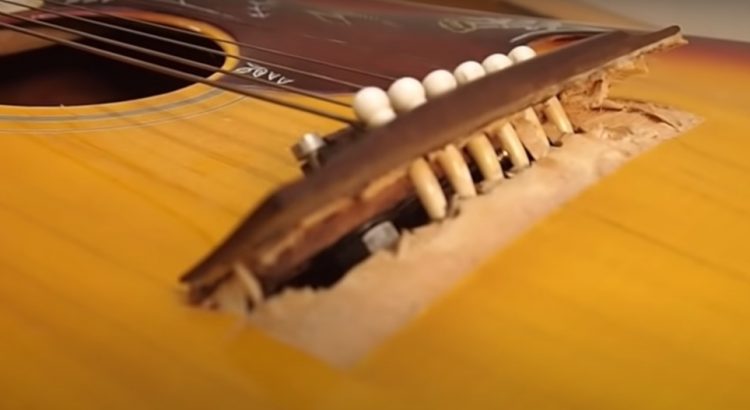
However, in case the bridge is not stuck very well and lifts, and it is being held down with nuts and bolts (yes, even with nuts and bolts, the string tension will lift the bridge), the hardware will rip through the bridgeplate (below the top) and the top. The owner, then, is left with two options: throw the guitar away, or, have it repaired at great expense. This is major surgery we are talking here!

So, why do manufacturers continue to hold down bridges with nuts and bolts? The world over, most manufacturers have given it up as a bad idea. Only in India, do we find manufacturers clinging on to it. Simply put, there are two reasons for them doing so. 1) It is easier to use nuts and bolts than to REALLY clean the two glueing surfaces of all paint and finish to get a good wood-to-wood joint, and 2) in the mistaken belief that they are lending solidity to the structure!

Here’s one from an Indian manufacturer that I had the misfortune of looking at. Not right away, but a couple of years or so down the line, I won’t be surprised if it comes to me with a ripped top. The lines on the paper strips represent the amount the strips slip under the bridge.

I won’t name the manufacturer here, but I am sure they will be able to recognise their product.

The famed Gibson company may have learned its lesson and discontinued the practice of fastening bridges with nuts and bolts. When will Indian guitar manufacturers learn?