Solid vs laminate-wood guitars and their maintenance

If somebody shows you a ‘solid-wood’ acoustic guitar, what they mean to say is that the top of the guitar, its back and its sides are made of single pieces of wood. 

In comparison, a ‘laminate-wood’ acoustic guitar – as the name suggests – is made up of thin layers of different woods stuck/pressed together. So, the top may have a thin slice of spruce/cedar and layers of ordinary wood underneath. Likewise, the back and sides may have a thin layer of rosewood/mahogany/walnut on the very outside and thin layers of other woods underneath.

So, what is the difference? The difference, my friends, lies in the quality of sound that each instrument produces. 

Let me explain. Homogeneity and heterogeneity are paramount when sound and its transmission are being considered. Sound will travel through a single piece with ease and without any loss of energy, and yet, through different pieces – no matter how well they are stuck – there will certainly be loss in amplitude, sustain and overall sound quality. 

Workmanship aside, why do you suppose the top end Martin and Taylor acoustic guitars cost so much? Because one VERY BIG factor influencing sound is the wood used. Top end models of these brands use only solid wood and they ring true. 

In the US, an acoustic guitar with a solid top and laminated back and sides costs somewhere around $600-$700 (Rs 42,000 – Rs 49,000). A solid-wood guitar could cost $1300 – $1500 (Rs 91,000 – Rs 1,05,000). 

In India, you can lay your hands on a six-string contraption for as little as Rs 1,500. I leave it to your imagination what wood manufacturers may be using in such instruments and what these instruments would be sounding like. And for those who wish to give the cheap-labour counterargument, how cheap is the labour in India that a decent instrument costs Rs 42,000 in the US and Rs 1,500-2,000 in the country?


Checking for solid/laminate wood
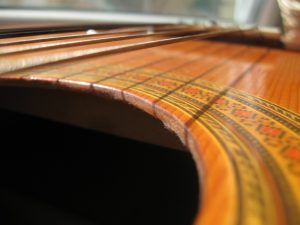
On the right is an instrument with solid-wood top and on the left, a laminate-wood topped instrument. How can I say that? By looking at the wood along the soundholes of the two guitars. The grain of wood (the pattern that wood forms) runs right through the wood and the side of the soundhole shows it too.

In contrast, the soundhole on the left, clearly shows that different woods have been used to make the top of the instrument. 

While looking at a guitar, if for some reason you are unable to make out from the soundhole of an instrument whether it is a solid or laminate, shine a torch through the soundhole of your instrument. If you see a wood grain you are assured 50% that it is a solid-wood instrument. However, if you can match the pattern inside with the one directly outside, you can rest assured that it is a solid-wood instrument.

But then why did I say that seeing wood grain on the inside of a guitar makes you just 50% safe? That’s because people are smart. They use a thin veneer (slice) of rosewood/mahogany/walnut on the inside and on the outside, making up the thickness with ordinary wood in between!


The maintenance of both

Despite being a high-dollar guitar, the solid-wood instrument is the one that requires a lot of care though not too much of maintenance. Weather fluctuations and climate changes affect the homogeneous wood immensely. However, in the absence of that care, things can go awfully wrong, rectifying which can rip a huge hole in your pocket. 

In contrast, the laminated acoustic guitar is a much more sturdy instrument, standing up to the vagaries of nature stoutly. The warping, bending so characteristic of the solid-wood instrument is not seen here. But then the quality of wood used takes a lot out of the sound that it produces. 


So, which one should you buy?

The guitar made from laminated wood is (usually) like a contented child, not giving much trouble ever, but the solid-wood guitar is like that pampered brat who demands attention all the time, and is pricey to boot. 

But once you play a solid-wood instrument for some time, no other guitar will match up to the quality of sound it produces and its projection. If you can stand the tantrums of this baby, there is no better.

In India, you can get a ‘proper’ guitar upwards of Rs 6,500 – Rs 7,000 which would have a solid top and some fairly decent tuning machines on it. A solid-wood guitar will cost upwards of Rs 18-20k. 

But should you shell out that much? The cards are on the table, you decide!
Cardinal sin: steel strings on Classical/Spanish Guitar!

This one is due next. Someone decided to throw on steel strings on a Classical Guitar and get a bigger bang for their buck: foolishness brought on by ignorance!

Every acoustic guitar – Western Flat Top (Steel String), the Resonator, Classical (Spanish), the Archtop – was made keeping a particular music in mind. That is to say each of their constituent elements vary a bit in size, shape and dimension to give it that characteristic sound, which is suited for THEIR kind of music.

The Classical Guitar is meant to play Flamenco, Gypsy Jazz and Western Classical music, though it would be wrong to say that you can play ONLY that kind of music on it. To produce that particular sound, the bracing pattern, the braces themselves, the thickness of the top of the guitar, the neck of the guitar and the strings are vastly different from any other guitar.


The Guitar Top and its Braces

According to Andrew Enns, head luthier at the classical-guitar company, Córdoba Guitars (a respected name in the Classical Guitar world), the bracing and thickness of the top play an important role in the difference between a classical and a steel-string guitar. “Nylon-string tops are thinner, with smaller, more flexible braces, while steel-string guitars have thicker tops with larger, more rigid braces. The principle behind both is the same, to make the guitar strong enough to hold the strings at pitch, yet flexible enough to vibrate when the strings are plucked,” Enns says.


The Bracing Pattern

Fan Bracing in a Classical Guitar. Pix courtesy: danielbrauchli.com
X-Bracing in a Steel-string Guitar. Pix courtesy: maurysmusic.com

Again, to facilitate the greatest vibration of the top in response to the lightest touch of the strings, the Classical Guitar – classically – is braced with wood strips in a pattern that has come to be known as fan bracing. In contrast the steel string guitar has a (slightly) thicker top and heavier bracing, called ‘X-bracing’ which assists the working of steel strings.

Also, the lighter nylon strings that go on the Classical Guitar work best with that light bracing and light top. If you place the same strings on a steel-string top guitar, they will sound dead and useless.


The Neck

Classical guitar neck
Cross-section of Steel-string Guitar neck with truss rod. Pix courtesy: frets.com
The truss rod nut as seen from the soundhole

Under the fretboard/fingerboard, the common steel string guitar has a furrow running almost through the length of it. In this cavity sits the truss rod. The job of the truss rod is to counter the stress that the steel strings exert on the neck and can be worked from the outside to bend the neck in one direction or another.

Contrastively, the Classical Guitar neck has no such feature, for the possibility of it facing any such tension does not exist. New-age luthiers have begun experimenting with carbon fibre strips implanted in the neck, but then these cannot be worked like the truss rod can. They are just there to reinforce the neck and give it strength. Also, even with these implants, the Classical Guitar neck is incapable of taking the strain of steel strings.


The strings

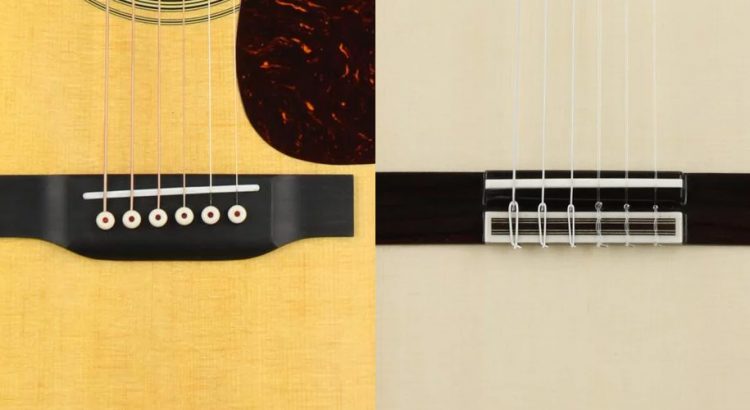
Steel-string (left) and Classical guitar bridges

The total tension that classical (nylon) strings exert on the guitar top is never more than 40 – 41 kg. Compare that to the 70-72 kg tension that (the lightest) steel strings exert.

Without the typical bracing pattern, the size of braces to support the top, and a truss rod countering that 72-kg force, any guitar will fold on itself.


And so…

If you do not want your instrument to fold on itself, PLEASE do not make the mistake of putting steel strings on a Classical Guitar!

And since it’s the season for returns…


Remember this?
Well, it was back in exactly the same condition as when I first laid eyes on it – with its bridge lifting!!

And why? Because of one silly strip of useless wood in the wrong place.

What you see in the mirror is called the bridgeplate – the one with the six holes. I am afraid it is not a very good photograph but look closely at the top left corner of the strip and you can just about see that it is no more than 2 – 2.25 inches across. Also, it is not made of a hard wood like rosewood or maple but an inferior variety of spruce (I am guessing).

Its purpose is to help the top of the guitar bear the 70 – 80 kg tension that tuned-to-pitch strings exert, by providing support. So, a small, thin bridgeplate is incapable of doing its job, and thus, why this instrument returned.

The flip side is that if you put in too big or thick of a bridgeplate, it compromises the sound of the instrument, for it hampers the movement of the top.

After I took the bridge off the first time, the top was like this:

This time, when I took off the bridge, it looked like this:

Now there were two things that could be done: a) make a new, better bridgeplate, or, b) give it more, a lot more of the earlier treatment. With a more expensive guitar I would have ventured to replace the bridgeplate, but with this one I decided to take the second route.

But I needed something that would support and straighten the bridgeplate, as also the top to straighten out – something that would help the bridgeplate behave itself over at least half a decade of the instrument’s life. So, I had some fashioning to do: the right sized block of wood. To know that I marked the cross brace impression on the top with a whiteboard marker. In between the two red lines and under the top, my block should be able to fit in.

This piece of wood would sit against the bridgeplate, while another block of wood would sit against area where the bridge would be. But before I locked everything in, it needed some heat to give a chance to the bridgeplate and top a chance to straighten out. And so, boiling water to soak the bridge area as also the bridgeplate.

But before I soaked it, I pushed in an old tee-shirt to soak in the extra water and to protect the back of the guitar.

 Clamp everything together and let it rest for a couple of days. And that is exactly what I did.


After clamping everything together and leaving it for three days, it turned out like this

I repeated the process and left it for another four days before I loosened the clamps and left it to dry for four days. Later, glueing the bridge back on was a piece of cake.

An oiling and cleaning of the fretboard and bridge, some new strings and Snow White’s ready to sing again!!